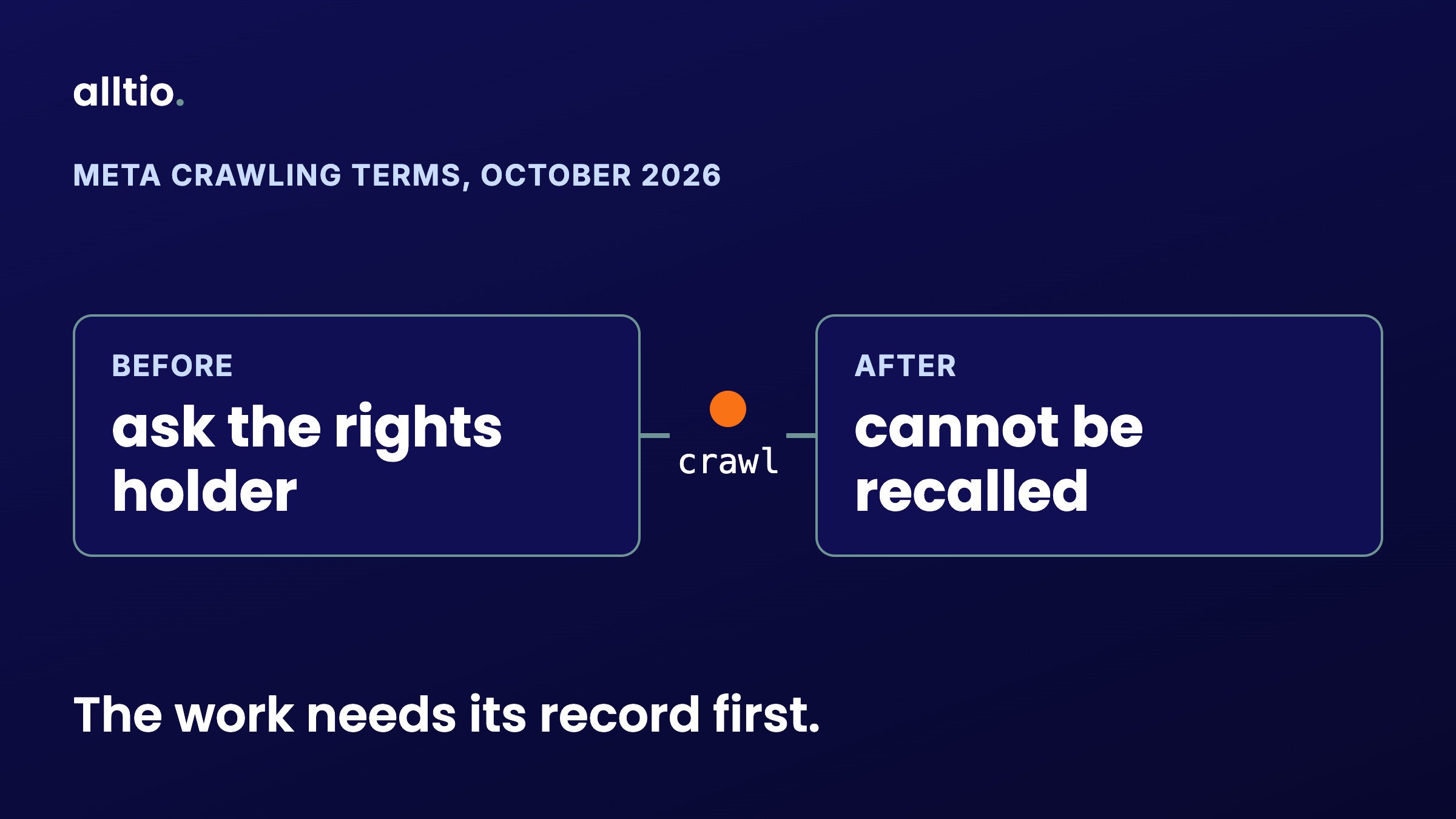
Complaints now before the European Commission and the UK competition authority seek to freeze Meta's crawling terms because a crawl cannot be recalled, and the remedy Europe's publishers propose rests on a fact no crawler can read today: whose each work is.
Key facts
- On October 22, 2026, the Movement for an Open Web asked the European Commission and the UK Competition and Markets Authority for interim measures suspending Meta's new commercial terms.
- Meta postponed the effective date of those terms, including the clause that authorizes its crawlers on websites associated with business accounts, from October 30 to November 20, 2026.
- The European Publishers Council asks that any use beyond the service a business requested require separate, express authorization from the relevant rights holder.
- Article 53 of the EU AI Act requires a training-content summary and a policy that respects rights reservations, and it does not require naming individual works.
- An Alltio record binds the fingerprint produced when a work is scanned on its creator's own device to the rights holder and the terms on which AI may use that work.
On October 22, 2026, the Movement for an Open Web, a campaign group whose members include publishers and digital advertisers, asked the European Commission and the UK's Competition and Markets Authority to impose interim measures suspending Meta's new commercial terms. Germany's publisher associations, BDZV and MVFP, had already asked the Commission to halt the crawling clause, and the CMA said it was in urgent discussions with Meta after meeting the company on October 21. When the European Publishers Council wrote to the Commission again on October 23, Meta had moved the effective date from October 30 to November 20. Meta maintains that the crawling terms apply only to its ads and business products and that content owners can still state preferences in robots.txt.
The case for speed is that a crawl cannot be recalled
The German associations put the urgency in operational terms. Once the content has been taken, they argued, the damage is done and practically irreversible, since nobody can reliably establish afterward which content went where. The Publishers Council pressed the same concern about material collected and absorbed into datasets, models, or competing services.
Competition law has an instrument shaped for exactly that risk. Article 8 of Regulation 1/2003 lets the Commission order interim measures, for a specified period and on a prima facie finding of infringement, where urgency arises from the risk of serious and irreparable damage to competition. A measure of that kind can hold conduct still while a case runs, though it reconstructs nothing taken before it applies and was never built to say whose that material was.
The proposed remedy depends on a name the crawler does not carry
The Publishers Council's substantive demand is precise. Any use beyond what a requested service needs "should require separate, express authorisation from the relevant rightsholder," it wrote, adding that technical controls over crawler access cannot replace enforceable contractual limits. BDZV and MVFP rely on Article 6(12) of the Digital Markets Act, which obliges Meta, as gatekeeper for Facebook and Instagram, to apply fair, reasonable, and non-discriminatory conditions of access to its business users.
Both routes protect a business user, and on a platform the business user is an account. Authorization from the relevant rights holder becomes express only when the party collecting content can establish, for each work at a given address, who that rights holder is. A national newspaper can answer for what its staff wrote. The independent specialist whose analysis sits on someone else's domain has neither a masthead to answer for it nor an association filing in Brussels.
Antitrust opened music licensing, and the repertory made it payable
In my experience in music licensing, the closest precedent is the antitrust settlement that still governs American performing rights. The Justice Department first entered consent decrees with ASCAP and BMI in 1941. As amended in 2001, the ASCAP judgment orders the society to grant any music user who asks in writing a non-exclusive license to perform all of the works in its repertory, and a rate court before a federal judge decides the fee when the parties cannot agree. The decree left the use in place and made a single license available to every user on request, so a broadcaster never had to locate the writer of each song it aired.
That obligation could be met because the repertory existed as a list before any license was sold. ASCAP's public database records the title, writers, publishers, and ISWC code of each work, along with the share ASCAP controls, and when it was redesigned in 2016 it covered about 10 million works. The regulator set the terms of access, while the register established whose work that access reached.
Europe assigns the reservation to the rights holder and leaves the work unnamed
Article 4(3) of the 2019 copyright directive permits text and data mining unless rights holders have expressly reserved their works in an appropriate manner, such as machine-readable means for content published online. Article 53 of the AI Act requires providers of general-purpose models to operate a policy that complies with those reservations and to publish a sufficiently detailed summary of training content, and neither duty requires naming individual works. Whatever the Commission decides about Meta, the law already places the choice with the rights holder and says nothing about how a crawler should read that choice work by work.
Express authorization needs a record of whose the work is
Alltio is the registry of works. A creator or publisher scans a work on their own device, the scan produces a fingerprint, and the record binds that fingerprint to the rights holder and a declaration of the terms on which AI may use the work. Registration is the provenance, and it records an answer to the question the Publishers Council's remedy presupposes, namely who the relevant rights holder is for a specific work, before any crawler arrives and whatever a platform's commercial terms happen to say.
None of the later steps is running yet. No payment is flowing today, and Alltio has no access to AI lab logs and cannot observe AI use. Labs meter AI compute tokens to bill the buyer of every answer, while nothing meters on behalf of the supplier of the knowledge inside it. Attribution waits until AI labs provide the usage records that show which registered works were used, after which settlement is metered in AI compute tokens and an off-ramp converts those AI compute tokens to currency.
Brussels may well freeze a clause before November 20. It cannot collect express authorization from tens of thousands of specialists one at a time, and no lab will attempt that either. Alltio delivers the long tail of specialist knowledge to AI labs as a collective, so a lab signs one agreement rather than tens of thousands, against records that already state whose each work is and on what terms. Creators and publishers can register their work at alltio.com/register.
Sources
- Reuters (Foo Yun Chee), "Publishers, advertisers call EU, UK antitrust regulators to suspend Meta's new commercial terms," October 22, 2026, via WSAU. https://wsau.com/2026/10/22/publishers-advertisers-call-eu-uk-antitrust-regulators-to-suspend-metas-new-commercial-terms/
- Resultsense, "Publishers ask CMA to suspend Meta's new commercial terms," October 23, 2026. https://www.resultsense.com/news/2026-10-23-meta-terms-cma-complaint-interim-measures/
- kress.de, BDZV and MVFP on Meta's crawling clause, October 22, 2026. https://kress.de/news/beitrag/156812-skrupelloser-diebstahl-verlegerverbaende-attackieren-metas-neue-crawling-klausel.html
- European Publishers Council, "Meta needs to draw a clear line between providing a service and appropriating rights from their business users," October 23, 2026. https://www.epceurope.eu/post/meta-needs-to-draw-a-clear-line-between-providing-a-service-and-appropriating-rights-from-their-busi
- PPC Land, "Meta delays website-crawling terms to Nov 20 after publisher complaints," October 23, 2026. https://ppc.land/meta-delays-website-crawling-terms-to-nov-20-after-publisher-complaints/
- Nieman Lab, "Meta's new commercial terms will allow the scraping of news sites, legal experts say," October 15, 2026. https://www.niemanlab.org/2026/10/metas-new-commercial-terms-will-allow-the
- Regulation (EC) 1/2003. https://eur-lex.europa.eu/legal-content/EN/TXT/HTML/?uri=CELEX:32003R0001
- Regulation (EU) 2022/1925 (Digital Markets Act). https://eur-lex.europa.eu/eli/reg/2022/1925/oj
- US Department of Justice, ASCAP and BMI consent decrees. https://www.justice.gov/opa/pr/department-justice-opens-review-ascap-and-bmi-consent-decrees
- US Department of Justice, letter in Pandora v. ASCAP, March 6, 2015. https://www.justice.gov/atr/case-document/file/628831/dl
- ASCAP, "ASCAP Launches Redesigned Public Repertory Database," July 13, 2016. https://www.globenewswire.com/news-release/2016/07/13/1337636/0/en/ASCAP-Launches-Redesigned-Public-Repertory-Database.html
- Directive (EU) 2019/790. https://eur-lex.europa.eu/legal-content/EN/TXT/HTML/?uri=CELEX:32019L0790
- Regulation (EU) 2024/1689 (AI Act). https://eur-lex.europa.eu/eli/reg/2024/1689/oj
- AI Act Article 53 text. https://artificialintelligenceact.eu/article/53/
- European Commission, template for training content summaries. https://digital-strategy.ec.europa.eu/en/faqs/template-general-purpose-ai-model-providers-summarise-their-training-content
- Alltio registration. https://alltio.com/register
 Fingerprinted