
A complaint filed in Chicago on October 30 sets the board's claim of auditable lineage against a 280,000-hour music corpus that, it alleges, named no recordings, rights holders, or licenses.
On October 30, 2026, an Alphabet shareholder, Phil Rosen, filed a derivative complaint in the US District Court for the Northern District of Illinois against 13 defendants, among them Sundar Pichai, Larry Page, Sergey Brin, and Kent Walker, the company's chief legal officer. The 79-page complaint, case 1:26-cv-13499, alleges that Google trained music models including Lyria and MusicLM on copyrighted recordings and lyrics without licenses. A derivative claim is brought on the company's behalf, so any recovery would go to Alphabet rather than to the plaintiff. Every factual statement in it remains an allegation that no court has tested.
The board described a system of record for every AI asset
The complaint's most useful exhibit is the board's own prose. At the 2025 annual meeting, shareholders voted on Proposal 11, which asked for a report on AI data usage oversight, and the board recommended against it. Its statement in opposition, as the complaint quotes it, said: "We annotate all AI assets with detailed tracking of data origins and usage." The same passage pointed to opt-out controls for publishers and a governance process for generative AI launches.
The complaint then turns to MusicLM. It alleges that the model's semantic and acoustic stages learned from five million audio clips totaling 280,000 hours of music, and that Google identified none of the specific recordings, rights holders, or licenses in that corpus. It also alleges that the copyright information naming the artists was stripped out. Read together, the two passages describe a narrower dispute than the coverage suggests, because a lineage statement and a missing owner can both be accurate at the same time.
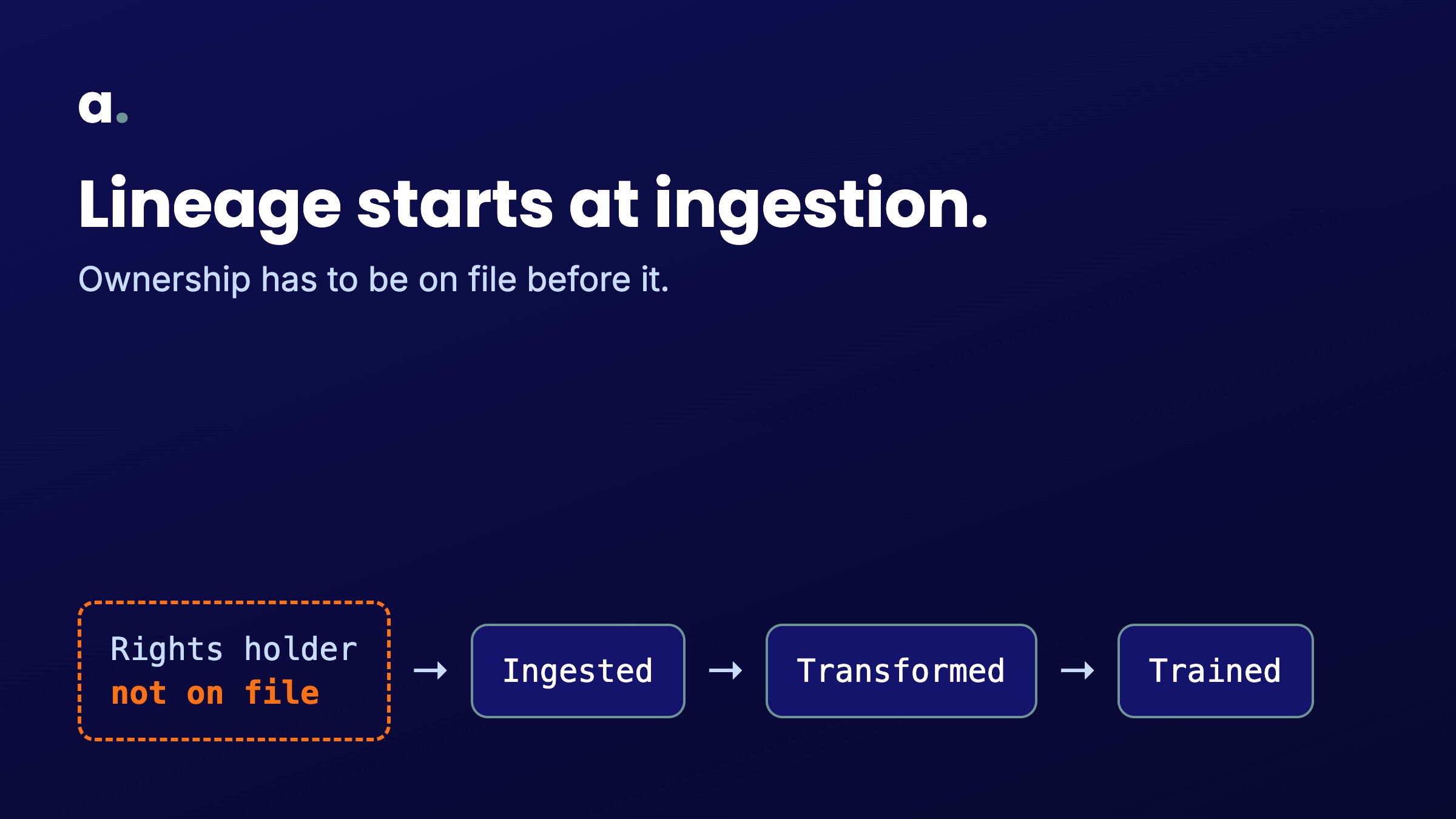
Lineage begins at ingestion, and ownership is decided before it
Google's own cloud documentation defines data lineage as a map of a dataset's life cycle: where it originated, how it moved and changed, and where it sits now. The first entry is written when data enters the system. For a clip cut from a hosted video, the origin field can name the video and the date it was pulled. It can name a rights holder only if one was attached to the file on arrival, which is the very information the complaint says was removed.
A board can therefore attest to lineage in good faith and still be unable to tell a shareholder whose work sits inside a model. Ownership is a fact about the work, and it has to be recorded outside the pipeline and ahead of it, because no transformation job downstream can restore a field the source file no longer carries. In my experience in licensing, usage that cannot be matched to a rights holder waits in suspense until someone proves a claim, and the burden of that proof lands on whoever is least equipped to carry it.
Shareholders now ask for the detail Europe's summary leaves out
The derivative form moves the question from the courtroom to the boardroom. The complaint argues that directors authorized proxy statements describing AI governance while infringement risk accumulated, and it seeks damages payable to Alphabet along with changes to how the board oversees compliance. Another shareholder proposal discussed in the complaint quoted Alphabet's own risk disclosure, which acknowledges that its AI work may give rise to risks related to intellectual property infringement. For a C-level reader the exposure is concrete, since a disclosure about data controls becomes a liability once someone shows the controls never captured ownership.
Europe asks the same question at a lower resolution. Article 53 of the EU AI Act requires providers of general-purpose models to publish a sufficiently detailed summary of training content and to operate a policy that complies with rights reservations, and it does not require naming individual works. A summary at that resolution can satisfy the AI Office while leaving a board with the blind spot the Chicago complaint describes, since neither document has to say who owns any single file.
The owner field has to come from the rights holder
Alltio is the registry of works. A creator or publisher scans a work on their own device, the scan produces a fingerprint, and the record binds that fingerprint to the rights holder and a declaration of the terms on which AI may use the work. Registration is the provenance, and it supplies the one field a lab's lineage system cannot generate for itself. Alltio registers text today, so the recordings in this complaint fall outside its scope, though a specialist's technical paper reaches a training pipeline with the same empty field.
An Alltio record is not a US Copyright Office registration and confers no statutory remedy. No payment is flowing, and Alltio has no access to AI lab logs and cannot observe AI use. Attribution follows once AI labs provide usage records showing which registered works were used, settlement is then metered in AI compute tokens, and an off-ramp converts those AI compute tokens to currency.
Labs already meter AI compute tokens to bill the buyer of each answer, while nothing meters on behalf of the supplier. A board that wants auditable lineage to include ownership needs the owner on file first, and for the long tail of specialist knowledge no lab will negotiate with tens of thousands of individual rights holders to get it. Alltio delivers that long tail to AI labs as a collective, under one agreement, against records that already state who holds each work and on what terms.
Creators and publishers can register their work at alltio.com/register.
 Digital ID