A joint appeal published on October 27 by 14 publishers' associations, collecting societies, and journalists' unions asks Europe for consent, a reversed burden of proof, and arbitration, and each of the three is decided one work at a time.
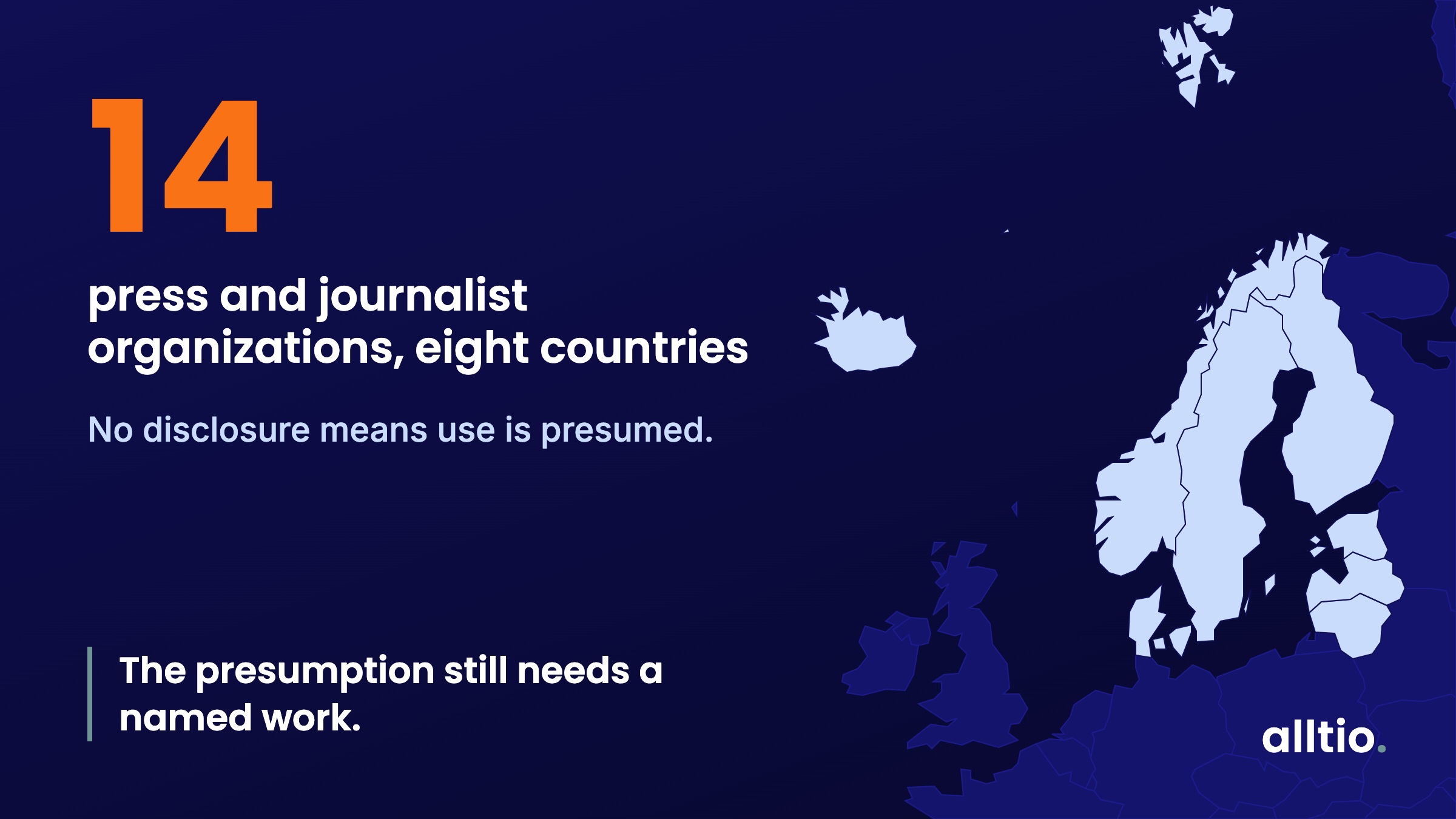
On October 27, 2026, 14 organizations from Sweden, Norway, Denmark, Finland, Iceland, Estonia, Latvia, and Lithuania published a joint appeal and a position paper on copyright and AI. The signatories span both sides of the newsroom: publishers' associations such as Tidningsutgivarna in Sweden and Mediebedriftenes Landsforening in Norway, the press publishers' collecting societies SPCMO and DPCMO, and the journalists' unions of every Nordic country. DPCMO is the one already in litigation, having taken OpenAI to the Copenhagen City Court after collective negotiations failed.
The paper asks for three things. Commercial AI scraping, it argues, was never meant to fall within the text and data mining exception in Article 4 of the 2019 copyright directive, so any commercial use of journalism should require an agreement. If an AI company will not disclose in sufficient detail what it used, or will not make the relevant datasets available to rights holders, the law should presume that the works were used in training, inference, or retrieval, and the company should carry the burden of proving otherwise. Because negotiations under the press publishers' right have produced no fair outcome, Europe or the member states should establish arbitration that decides remuneration and terms, although the paper insists that such a body "cannot require a publisher to enter into an agreement."
A reversed burden still starts with a named work
The presumption is the sharpest of the three demands, since it converts an AI company's silence into evidence against it. It does not relieve the claimant of its own half of the case. A rights holder invoking it still has to identify the works it says were used and show that it holds the rights in each, and the company then rebuts work by work. An association can speak for a sector, while a court rules on works.
The only per-work payment made so far shows what that step costs. The $1.5 billion Bartz v. Anthropic settlement covered 482,460 books, and a book entered the list only if it could be matched to an existing copyright record. A newsroom archive holds millions of articles, many of them written by freelancers and few of them recorded anywhere outside the publisher's own content system.
Retrieval is the one layer where the presumption can be tested
The paper is right to reach past training. Training ends in model weights, from which no one can recover a particular article, so a dispute about training can only be settled by estimate. Retrieval works differently, because the system fetches a specific page at the moment it composes an answer, and that fetch can be logged. It is the one point at which the use of a specific work can be shown rather than inferred, provided the work carries a record of whose it is.
An arbitrator cannot price use that nobody meters
Arbitration needs a quantity to work on. Telecom operators settle interconnection and roaming against call detail records, and no regulator setting a termination rate has to guess how many minutes crossed the network. Nothing in the AI chain meters use on behalf of the supplier. Labs meter AI compute tokens to bill the buyer of each answer, and the arrangements publishers have signed with AI companies so far are access deals that buy a catalog for a period without recording what was used, by whom, or how often.
An arbitrator working from that record can price a catalog and nothing finer. The result would be the same all-you-can-eat structure whose outcomes the signatories call unfair, set by a tribunal instead of by negotiation.
Publishers and unions signed one paper and will divide one payment
The appeal puts employers' associations and journalists' unions under the same text, which is unusual, and the alliance will be tested when money arrives. A payment made to a publisher for a catalog says nothing about which journalist wrote the articles that were retrieved. On the day the appeal appeared, the Textbook and Academic Authors Association told the court administering the Bartz settlement that some academic publishers are claiming 85% to 95% of the payment for their authors' books, according to ChatGPT Is Eating the World. A record that names the author alongside the publisher settles that division before it becomes a dispute.
A court can stop the crawl, and only the crawl
The next day showed both the reach and the limit of enforcement. On October 28, the Oslo District Court granted a temporary injunction to ten Norwegian media groups represented through Mediebedriftenes Landsforening. It bars Meta from bringing into force commercial terms that, according to the petitioners, would let it collect their articles, images, and video, paywalled material included, and use them to develop AI products. The order holds until a court decides whether the terms are lawful. It prevents collection, cannot recall anything already collected, and, like the presumption, operates on the petitioners' content as a body rather than on any identified work.
The record has to exist before the claim
Alltio is the registry of works. A creator or publisher scans a work on their own device, the scan produces a fingerprint, and the record binds that fingerprint to the rights holder and a declaration of the terms on which AI may use the work. Registration is the provenance. An Alltio record is not a US Copyright Office registration and confers no statutory remedy, but it names the work and its rights holder before any presumption, arbitration, or settlement has to.
No payment is flowing today, and Alltio has no access to AI lab logs and cannot observe AI use. Attribution follows once AI labs provide the usage records that show which registered works were used, settlement is then metered in AI compute tokens, and an off-ramp converts those AI compute tokens to currency. Alltio delivers the long tail of specialist knowledge to AI labs as a collective, so a lab signs one agreement rather than tens of thousands, against records that already state whose each work is and on what terms.
Creators and publishers can register their work at alltio.com/register.
 Fingerprinted