Woongjin Booxen apologized to Korean publishers on October 21 for supplying 165.69 metric tons of books to Anthropic's procurement contractor, and the episode shows a purchased copy reaching a model with every record of its rights holder left at the warehouse.
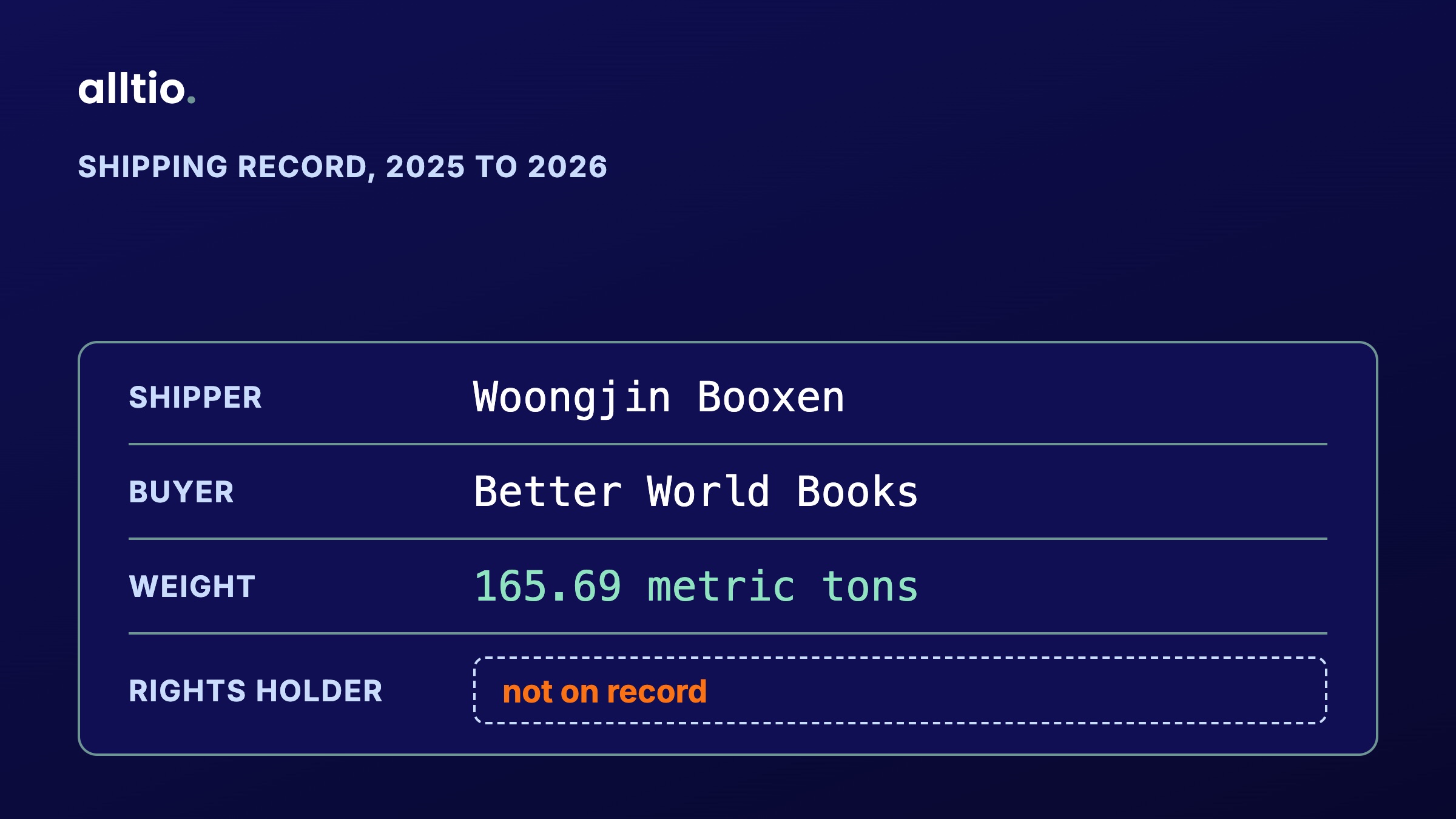
On October 21, 2026, Woongjin Booxen, South Korea's largest book wholesaler, apologized to the Korean Publishers Society and the Korean Publishers Association over its sales to Anthropic. Between March 2025 and June 2026 it shipped 165.69 metric tons of Korean-language books, roughly 414,000 volumes, to Better World Books, the company Anthropic contracted to buy and deliver them. The wholesaler says the orders went through conventional supply procedures, and it now promises tighter verification of overseas orders and consultation with publishers on bulk sales.
Import records exposed the trade, and Korea JoongAng Daily traced the shipments from Busan to Long Beach, Los Angeles, and Tacoma before describing what happens next. A contractor called Datamation cuts the books apart, scans the pages, passes the data to Anthropic, and discards the paper. Woongjin confirmed the supply contract and declined to name the titles, citing confidentiality terms.
A purchase moves the copy and leaves the terms behind
In the United States the only ruling on this route favors the buyer. In June 2025 Judge William Alsup held in Bartz v. Anthropic that buying print books, scanning them, and destroying the originals was fair use, while the pirated library Anthropic had downloaded was not. The $1.5 billion settlement that followed compensated the pirated downloads, so books acquired the way Woongjin's were acquired sit on the side of the line where one retail sale closes the account.
That sale is metered once, by weight at the dock and by invoice at the wholesaler, and never again. Every answer later drawn from those pages is billed to its buyer in AI compute tokens, while nothing meters on behalf of the supplier of the knowledge inside it. The author of a regional history or an economics monograph in one of those containers holds no record that links her work to the scan, and the wholesaler that knows the title list cites a confidentiality clause.
Seoul's publishers want disclosure, and bulk orders now reach used-book dealers
Pressure in Seoul has shifted from complaint toward legislation. The Korean Publishers Society issued an appeal stating that "AI companies must pay fair compensation to publishing rights holders," and an appeal addressed to the government and the National Assembly demands that AI companies disclose their training sources. Earlier this month Kyobo Book Centre, the country's largest bookseller, refused an overseas order for 100,000 books, each a different title, because the company placing it was not the end recipient.
Verification at a wholesaler's counter checks who is buying. It cannot tell a writer that one of her books left Busan in a container, and thousands of Korean rights holders have no practical way to audit a distributor's export ledger. Reporters have also found bulk orders in Germany, in Tokyo's used-book district, and in Korea, where an American distributor sought used Korean books by the container. In a used-book sale the publisher has no part in the transaction at all.
Europe asks for a summary, and the summary stops above the title
A provider placing a general-purpose model on the European market answers for this route wherever the scanning took place. Recital 106 of the AI Act applies the copyright obligation regardless of the jurisdiction in which the acts underpinning training occur, and Article 53 requires a policy that complies with rights reservations under Article 4(3) of the 2019 copyright directive, together with a sufficiently detailed public summary of training content. Neither duty requires naming individual works, and the Commission's template sets different levels of detail by source type to protect providers' trade secrets.
Korean law offers less. The country has no specific rules on AI training and copyright, and a 2023 amendment that would have required consent failed. A publisher in Seoul can therefore read a European summary of a model's sources and still find no line that tells it whether its own catalog went into the scanner.
Libraries buy a copy once and still pay the author per loan
Book publishing already runs a meter that outlives the sale. Under the Public Lending Right Act 1979, the United Kingdom pays authors, illustrators, translators, and other rights holders each year for library loans of their books, and only editions registered with the scheme qualify. On October 21, 2026, the government opened consultation on a proposed rate of 13.63 pence per loan for the 2025 to 2026 scheme year, calculated by dividing the fund by registered loans reported from every statutory public library in the country.
The library owns its copy outright, much as Anthropic owns the paper it bought through Woongjin. The lending right attaches to the work, the register states whose each edition is, and the loan count becomes a payment without any author negotiating with a single library authority. Without the register, the British Library could record every loan and still have no one to send the money to.
The record has to exist before the copy is sold
Alltio is the registry of works. A creator or publisher scans a work on their own device, the scan produces a fingerprint, and the record binds that fingerprint to the rights holder and a declaration of the terms on which AI may use the work. Registration is the provenance: a statement of whose the work is and on what terms, made by the rights holder and held apart from any sale of a copy.
The steps after registration depend on the labs. No payment is flowing today, and Alltio has no access to AI lab logs and cannot observe AI use. Attribution follows once AI labs provide the usage records that show which registered works were used, settlement is then metered in AI compute tokens, and an off-ramp converts those AI compute tokens to currency.
Korea's publishers are pressing their case one appeal at a time, and no lab will sign separate terms with the thousands of writers whose books filled those containers. Alltio delivers the long tail of specialist knowledge to AI labs as a collective, giving a lab one agreement in place of tens of thousands, against records that already state whose each work is and on what terms. Creators and publishers can register their work at alltio.com/register.
 Fingerprinted