A complaint filed on October 23 asks a federal court to make Anthropic account for its training data, and alleges that its cleaning pipeline was chosen for how thoroughly it removed songwriter credits and copyright notices.
On October 23, 2026, the companies and family trusts that own or control 274 compositions recorded by Elvis Presley sued Anthropic in the US District Court for the Northern District of California. The complaint in ABG EPE IP LLC v. Anthropic PBC, No. 5:26-cv-12473, alleges that Claude models were trained on the lyrics and reproduced them in outputs, that access controls were circumvented, and that copyright management information was stripped before training. Alongside damages and an injunction, the plaintiffs ask for an order compelling a complete accounting of the training data, scraping activity, and datasets that involve their works. None of the allegations has been tested in court.
A court order is the only route to a usage record today
The request for an accounting matters more than the damages figure, because it asks a judge to compel the one input attribution depends on: a record, held by the lab, of which works went into which datasets. No contract, standard, or regulator obliges a lab to produce that record work by work. A rights holder who wants it has to file suit, survive the motions, and win the order.
The plaintiffs can at least name what they are looking for. Exhibit A lists the 274 compositions by title, which gives any accounting a schedule to be matched against. Without such a list, a complete disclosure of training data would amount to an inventory of text with no column stating whose each passage is.
Corpus hygiene treats the ownership line as noise
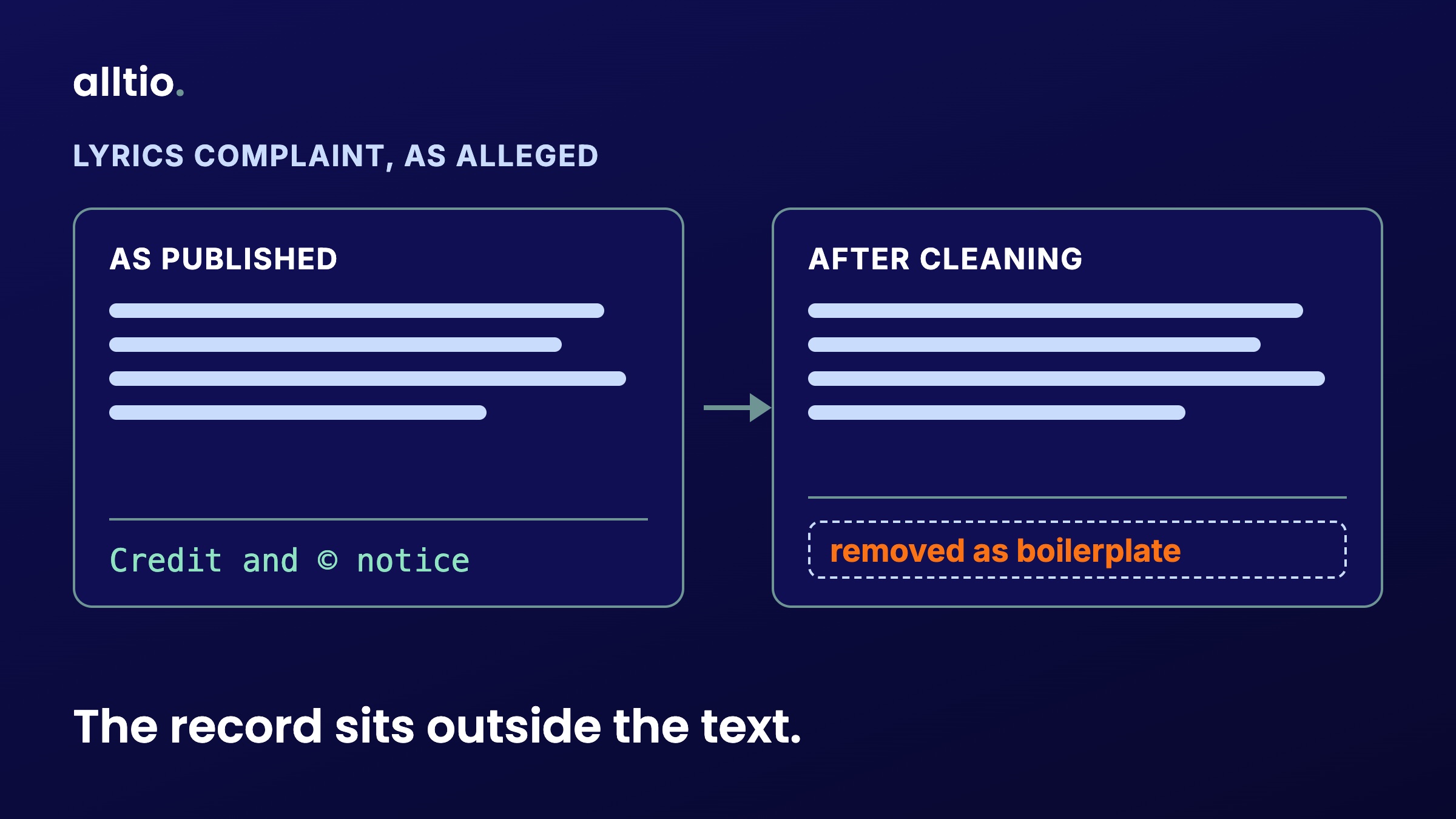
The complaint alleges that Anthropic tested three extraction tools, Readability, Newspaper, and jusText, rejected jusText because it left footnotes carrying owner names and copyright notices in place, and chose Newspaper because it removed them more thoroughly. According to the complaint, Anthropic referred to those notices as "useless junk." That paragraph rests on publicly available sources and on information and belief, and it cites no document.
Whatever a court finds about intent, the practice described is ordinary corpus hygiene. The authors of The Pile, an open training dataset released in 2020, describe menus and page footers as boilerplate and picked an extractor for their Common Crawl subset that, by their own account, discards more data than many alternatives. Credit lines and copyright notices tend to live in that footer, and a filter built to raise text quality has every reason to drop a line that repeats on every page and adds nothing to the passage above it.
The law protects a label that the pipeline is built to remove
Section 1202 of the US Copyright Act prohibits removing copyright management information, which it defines to include the title, the author, the copyright owner, and the terms of use. Liability turns on whether the person removing it knows, or has reasonable grounds to know, that the removal will induce, enable, facilitate, or conceal infringement. Article 7 of the 2001 InfoSoc Directive requires every member state of the European Union to protect rights-management information attached to a copy of a work or appearing with its communication to the public. Both provisions protect information that was present and was taken out, and neither supplies it where a work never carried it.
Europe's AI rules stop at the same level of detail. Article 53 of the AI Act requires providers of general-purpose models to publish a sufficiently detailed summary of training content and to operate a policy that complies with rights reservations under Article 4(3) of the 2019 copyright directive, and neither duty requires naming individual works. A music publisher in Munich or Madrid can read such a summary and still find no line that says whether a given work passed through the extractor.
Advertising moved the identity of an asset into a registry
Broadcast advertising met this problem with a code rather than a caption. Ad-ID, introduced in 2003 by the AAAA and the ANA, replaced ISCI, the manual coding system the industry had used since 1969. Each advertising asset receives an 11-character identifier from a registrar that checks it for uniqueness against every code already issued, and the metadata about the ad is retrieved through that code.
A spot can be copied, transcoded, and trimmed on its way to air while the answer to whose ad it is stays in a register that no edit to the file can reach. AI has no counterpart on the supply side. Labs meter AI compute tokens to bill the buyer of every answer, while nothing meters on behalf of the supplier of the knowledge inside it, and a routine quality filter can discard the supplier's name before training begins.
The record has to sit outside the text before anyone cleans it
Alltio is the registry of works. A creator or publisher scans a work on their own device, the scan produces a fingerprint, and the record binds that fingerprint to the rights holder and a declaration of the terms on which AI may use the work. Registration is the provenance, and the record is held in the registry, beyond the reach of any extractor that strips a footer. An Alltio record is not a US Copyright Office registration and confers no statutory remedy.
A record cannot say what a lab used, and joining a cleaned training text back to a registered work depends on usage records that only the labs hold. No payment is flowing today, and Alltio has no access to AI lab logs and cannot observe AI use. Attribution follows once AI labs provide the usage records that show which registered works were used, settlement is then metered in AI compute tokens, and an off-ramp converts those AI compute tokens to currency.
In my experience in licensing, an accounting works when the parties agree to it before the first use and rarely satisfies anyone when a court extracts it after the fact. The Presley catalog has publishers, trusts, and two law firms to pursue one, while the long tail of specialist knowledge has none of them, and no lab will negotiate an accounting with each of tens of thousands of rights holders. Alltio delivers that long tail to AI labs as a collective, so a lab has one agreement rather than tens of thousands, against records that already state whose each work is and on what terms. Creators and publishers can register their work at alltio.com/register.
 Fingerprinted