The Wikimedia Foundation asked a federal judge on October 29 to treat training and retrieval as separate uses, and its argument places the license obligation at the one moment an AI system fetches an identifiable page.
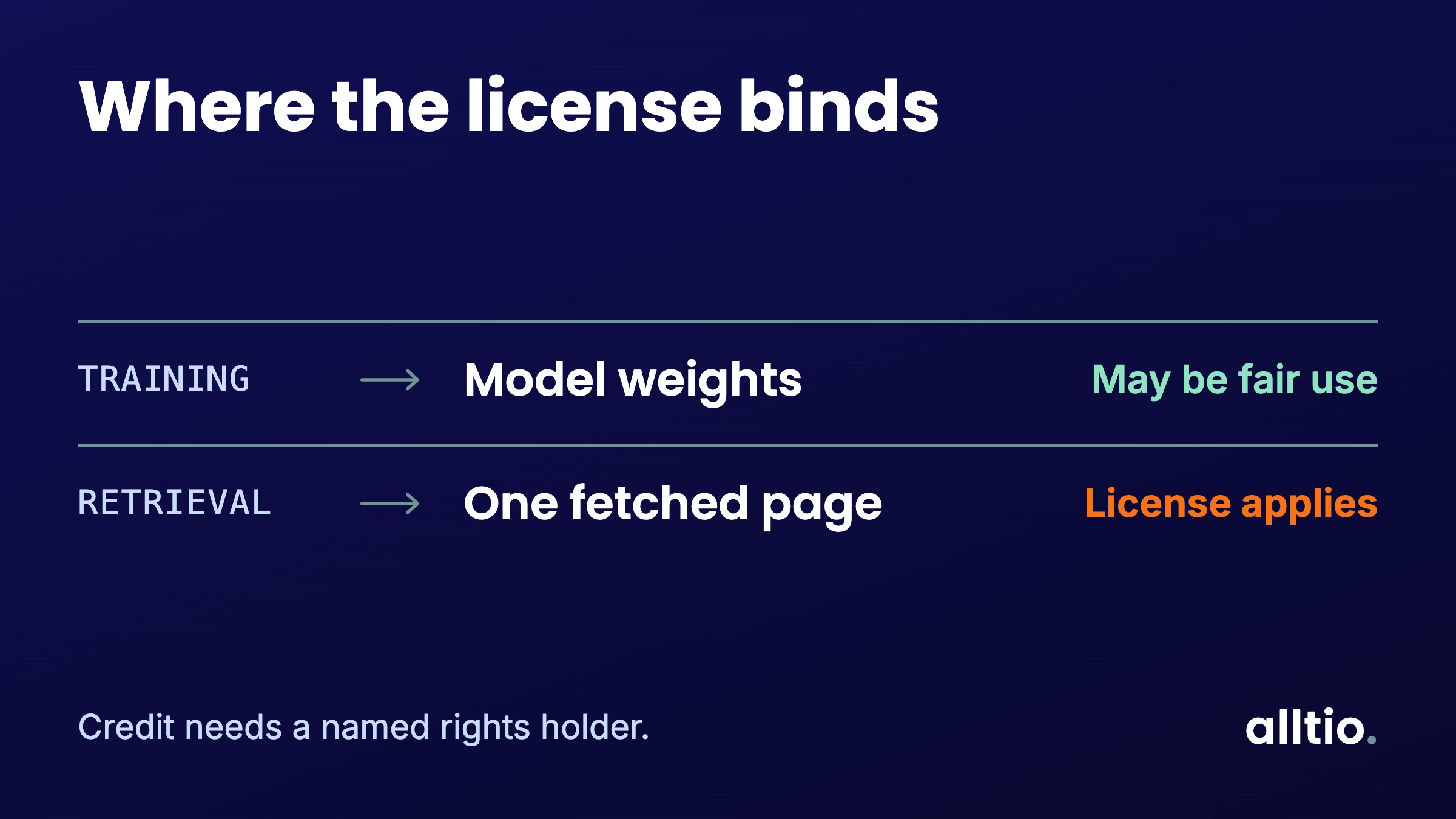
On October 29, 2026, the Wikimedia Foundation asked Judge Sidney H. Stein of the US District Court for the Southern District of New York for leave to file an amicus brief in In re: OpenAI, Inc. Copyright Infringement Litigation, the proceeding that gathers 12 lawsuits, The New York Times Co. v. Microsoft and OpenAI among them. The brief supports neither side. It argues that training may qualify as fair use when the resulting model is something new and different from its sources, while a product that retrieves and reproduces a page to answer a question should "respect the source's licensing requirements rather than treat the use as fair." The parties filed summary judgment motions on September 4, and as of October 30 the court had ruled neither on fair use nor on whether to accept the brief.
The author of the filing gives it weight. Wikipedia is widely regarded as one of the highest-quality datasets used to train large language models, and its steward accepted the training argument while rejecting the retrieval one. That moves the dispute to the layer where a specific page is fetched at a specific moment and much of it reappears in the answer. This is zero-click in its chatbot form: the passage is read inside the app, and the brief argues that such an answer competes with its source for the reader.
Retrieval is the one layer where a license has something to attach to
A trained model holds weights, and no one can point inside them to the article that shaped a given parameter. A retrieval system holds a document for the length of one answer: it fetches the page, places passages in the model's context, and composes the reply from them, so the use is discrete and can be logged. Wikimedia's license fits that event closely. CC BY-SA 4.0 requires credit to the original creators and requires adaptations to remain available under the same license, and a system can honor both conditions only at the moment it knows what it has just copied.
Wikipedia carries its terms on every page, and the long tail carries none
Wikipedia is an unusual supplier. Its license is published and applies across the project, and the Foundation offers high-volume access through Wikimedia Enterprise while asking other users to respect its public rate limits. A lab that wants to comply knows where to look.
Specialist knowledge outside the large platforms has no equivalent. A society's guidance note or an independent analyst's report is fetched by URL, and a URL is a location rather than an owner. When the same text sits at a second address, nothing in the fetch tells the retrieving system whose it is or what terms apply. A rule that puts the license obligation at retrieval therefore protects only the rights holders who can be identified at the moment of the fetch.
Munich reached the opposite answer on training, and Brussels is still taking views
Europe has not drawn the line where Wikimedia draws it. On November 11, 2025, the Munich Regional Court I held in GEMA v. OpenAI, Case 42 O 14139/24, that song lyrics memorized by a model are reproduced in it, that the text and data mining exception does not cover that reproduction, and that outputs repeating the lyrics infringed. It is a first-instance judgment. On that reading the training layer is no safe harbor either, and a lab serving both markets faces duties that begin at different layers on each side of the Atlantic.
The AI Act sets the regulatory floor. Article 53 requires providers of general-purpose models to publish a sufficiently detailed summary of training content and to operate a policy that complies with rights reservations, and it does not require naming individual works. The Commission's targeted consultation on copyright, which covers the use of protected content in AI, now closes on November 10 after an extension from November 3, so the question of where obligations attach is open in Brussels this month. Neither instrument tells a retrieving system who holds the rights in the page it has just fetched.
Music metered every stream and still could not find the owners
In my experience in licensing, a meter without an owner field produces an account that nobody can settle. On February 16, 2021, the Mechanical Licensing Collective announced that 20 digital service providers had transferred $424,384,787 in accrued royalties for uses that could not be matched to the owners of the songs, along with more than nine billion lines of usage data. Every one of those streams had been metered. The missing piece was the link from the line in the log to the person entitled to be paid, and the collective had to rebuild it after the fact.
AI has not reached even that stage. Labs meter AI compute tokens to bill the buyer of each answer, and nothing meters on behalf of the supplier of the knowledge inside it. If a court in New York or a rule from Brussels puts the license obligation at retrieval, the labs will write the logs that carry it. Those logs serve a rights holder only where each fetched passage can be joined to a record of whose it is.
The record has to name the work before the fetch
Alltio is the registry of works. A creator or publisher scans a work on their own device, the scan produces a fingerprint, and the record binds that fingerprint to the rights holder and a declaration of the terms on which AI may use the work. Registration is the provenance, and the record is keyed to the work's fingerprint rather than to the address from which a crawler happened to fetch it.
An Alltio record is not a US Copyright Office registration and confers no statutory remedy. No payment is flowing today, and Alltio has no access to AI lab logs and cannot observe AI use. Attribution follows once AI labs provide the usage records that show which registered works were used, settlement is then metered in AI compute tokens, and an off-ramp converts those AI compute tokens to currency.
Wikimedia can file a brief, publish a license, and run an enterprise service for heavy users. The specialists who hold the long tail of knowledge can do none of that alone, and no lab will negotiate terms with tens of thousands of them one at a time. Alltio delivers that long tail to AI labs as a collective, so a lab has one agreement rather than tens of thousands, against records that already state whose each work is and on what terms.
Creators and publishers can register their work at alltio.com/register.
 Fingerprinted