Five near-identical complaints filed in San Francisco on October 19 show what happens when the only usable record of a work is the one a court assembles after the use, and why specialist knowledge needs its record before anyone takes it.
On October 19, 2026, nearly 300 book authors filed five near-identical copyright complaints against Meta in the US District Court for the Northern District of California, alleging that Meta trained its Llama and Muse models on their books without authorization. These are individual actions rather than a class action, and one of them, Reno v. Meta, names 56 plaintiffs. Bloomberg Law reports that each author seeks statutory damages of up to $150,000 per work, the ceiling US law sets for willful infringement, and that the two firms behind the filings, Freedman Normand Friedland and Stris & Maher, expect to bring many more. None of the allegations has been tested, and Meta had not commented when the reports ran.
The settlement covered only works that already had a record
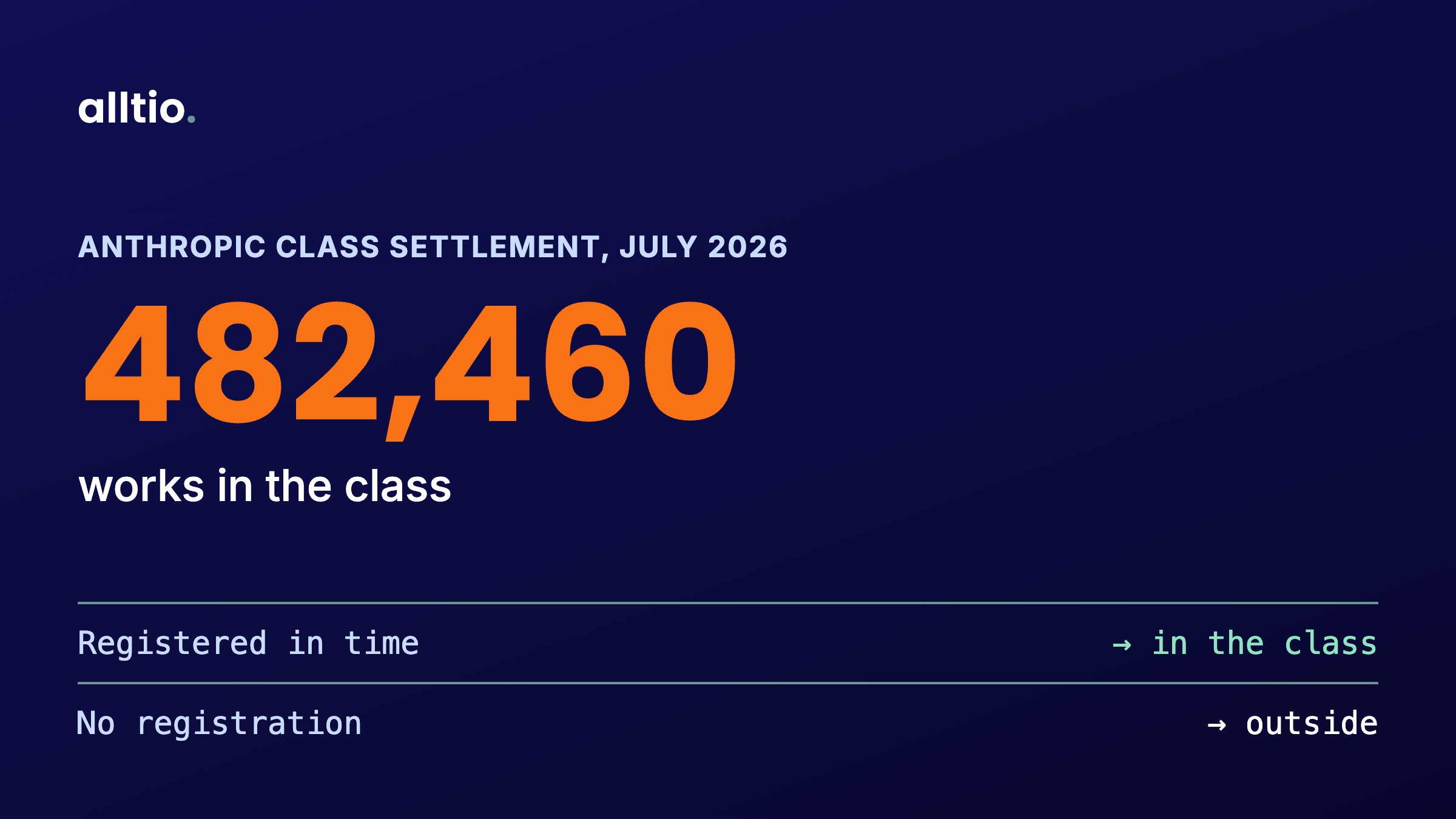
The same firms first represented authors who opted out of the Anthropic class settlement, and that settlement explains the strategy. The order granting final approval in July 2026 covers 482,460 works, and a book qualified only if it carried an ISBN or ASIN and had been registered with the US Copyright Office within five years of publication, and either before Anthropic downloaded it or within three months of publication. The court recorded 350 valid, timely opt-outs covering 1,802 works, so almost every eligible work stayed inside the settlement.
Section 412 of the Copyright Act applies the same gate to the remedy itself: no statutory damages for infringement that began before registration, outside that three-month window. Which works were in the settlement was decided by registrations their owners had already filed, and a work missing from those records was missing from the money.
Litigation by the unit is expensive for both sides
Individual suits recover the per-work remedy that a class dilutes, at the price of a separate plaintiff, a separate list of works, and possibly a separate deposition for every author. For a lab the exposure becomes hundreds of claims, each priced after the fact in a courtroom, years from the use. Neither route sets terms for the next use.
Most specialist knowledge sits outside both routes. Much of it is published as something other than a book, on a website or a platform, where an ISBN does not apply and nothing obliges the author to register before publishing. Its rights holders number in the tens of thousands, and a lab that will not sign tens of thousands of agreements has no appetite for tens of thousands of dockets.
Roaming solved the same arithmetic with a clearinghouse
In my experience in telecom, international roaming faced this problem at scale. Every operator needed a wholesale agreement with every network its subscribers might visit, and no operator settled those relationships call by call in court. The visited network writes usage into TAP files and sends them to a clearinghouse, which forwards them to the home operator, and the charges follow the volumes in the TAP file at the rates in the wholesale agreement. The clearinghouse never had to decide who the subscriber was, because that question was settled when the subscription was sold.
The arrangement worked because the subscriber was identified before the first call was placed, so the meter, the agreement, and the settlement all ran on an identity that existed in advance. AI has a meter on one side only. The buyer of every answer is billed in AI compute tokens, and the works inside that answer carry no identity a meter could record.
Brussels is asking how AI licensing should work
The European Commission's targeted consultation on copyright, open until November 3, 2026, includes a section on licensing and enforcement for generative AI. Whatever licensing model comes out of it will need the input the Anthropic settlement needed: which work, whose it is, and on what terms, fixed before the use rather than reconstructed in discovery.
The record has to exist before anything is metered
Alltio is the registry of works. A creator or publisher scans a work on their own device, the scan produces a fingerprint, and the record binds that fingerprint to the rights holder and a declaration of the terms on which AI may use the work. Registration is the provenance. An Alltio record is not a Copyright Office registration and carries no statutory remedy; its job is to identify the work and state its terms in advance, which a licensing agreement requires and a court spends years rebuilding.
None of the later steps is running yet. No payment is flowing today, and Alltio has no access to AI lab logs and cannot observe AI use. Attribution follows once AI labs provide the usage records that show which registered works were used, settlement is then metered in AI compute tokens, and an off-ramp converts those AI compute tokens to currency.
Nearly 300 plaintiffs in five complaints, with more promised, is what reaching the long tail looks like without a collective. Alltio delivers that long tail to AI labs as a collective, so a lab has one agreement rather than tens of thousands, against records that already state whose each work is and on what terms. Creators and publishers can register their work at alltio.com/register.
 Fingerprinted