Five French publisher organizations, the specialized press among them, joined the Commission's case against AI Overviews and AI Mode on October 29, and Google's own documentation shows why: the controls that keep a page out of the answer are the controls that keep it out of the snippet.
On October 29, 2026, five French organizations filed a complaint with the European Commission over AI Overviews and AI Mode, the two features that compose a generated answer inside Google Search, which reached France on July 22. The signatories are FNPS, the federation of the specialized information press, SEPM for magazine publishers, SPIIL for independent online news publishers, GESTE, and CPA. They are feeding French evidence into case AT.40983, which the Commission opened on December 9, 2025, under Article 102 of the Treaty on the Functioning of the European Union. The Commission's opening notice states the concern in one line: publishers cannot refuse the use of their content in these features without losing access to Google Search.
FNPS is the signature that matters most for the long tail. Its members publish titles in law and tax, medicine, agriculture, construction, engineering, and the sciences, which is specialist knowledge written by people who practice it. Their readers arrive with exact questions about a tax provision, a dosage, or a load rating, the queries an answer composed by Google can close without a visit. This is zero-click in its search form, with the answer composed inside Google Search itself, while chatbot answers are a separate channel with their own economics, and the complaint concerns search.
Google's documentation ties the answer to the snippet
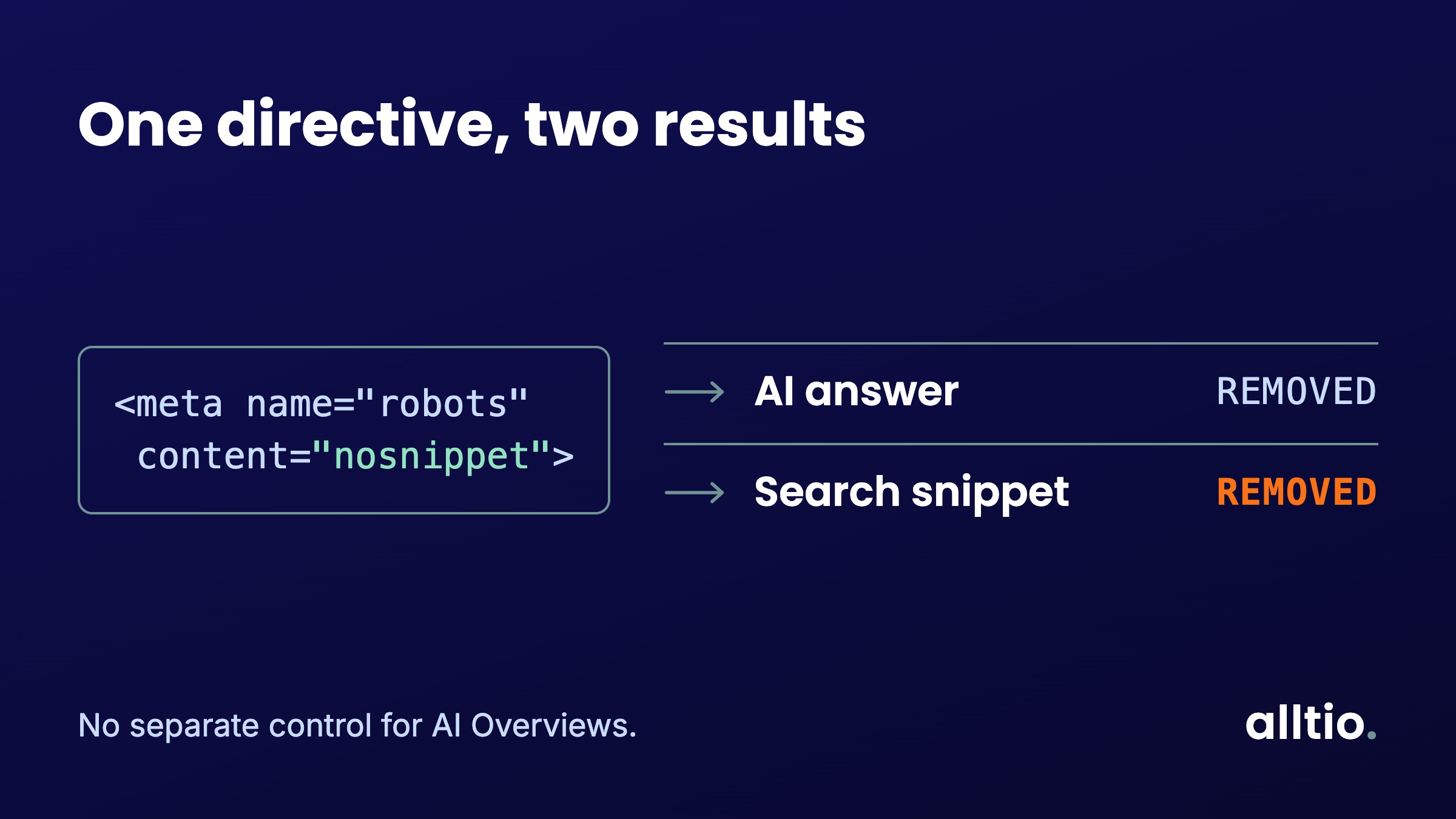
Google's Search Central page on AI features says there are "no additional requirements to appear in AI Overviews or AI Mode." A page that is indexed and eligible to show a snippet in Search is eligible for both. To limit what appears, the same page lists nosnippet, data-nosnippet, max-snippet, and noindex, all of them controls over how the page is shown in Search itself.
Google-Extended, the robots.txt control Google offers for AI, governs training of future Gemini models and grounding in Gemini Apps and Vertex AI, and Google states that it does not affect a site's inclusion in Search. The AI features page lists no separate control for Overviews or AI Mode. A specialist publisher that wants its analysis kept out of the composed answer therefore has to trim or suppress the excerpt that earns the click, and noindex takes the page out of Search altogether. In many publishing houses that directive is set by the IT or platform team, which is left to choose between two losses.
The answer page gains an auction while the supplier holds a display switch
On October 28, the day before the complaint, Google's chief business officer, Philipp Schindler, told Alphabet's third-quarter earnings call that ads in AI Mode are expanding into international markets, a step he called "taking our monetization footprint global for the first time." Google is also scaling ads within AI Overviews and AI Mode to more users and queries. The composed answer is becoming advertising inventory in its own right.
The publisher whose explanation supplied that answer holds one instrument, a directive that governs display. It carries no rights holder, no terms, and no record that the work was used. Labs meter AI compute tokens to bill the buyers of their models, and nothing meters on behalf of the supplier of the knowledge inside an answer.
Telecom never made a subscriber switch off the radio to decline one service
In my experience in telecom, the same radio carrier has always delivered voice, messaging, and data together, and no operator ever required a subscriber to drop the connection in order to decline one of them. The call detail record carries a service type for every event, so each event is rated against its own tariff and governed by its own terms while every service shares the network.
Google's crawler is a shared pipe without that field. One fetch serves the index and the answer, and every lever the publisher holds acts on the fetch or on the display, never on the use. That is the bundling the Commission's notice describes, and any remedy will need something that states the terms of each use separately.
Competition law rules on conduct, and the terms still have to attach to the work
The Commission can find an abuse and order Google to change how its features take content. Opening proceedings is not a finding, and nothing in the complaint reaches past Google to the other AI systems that read the same pages. Europe's copyright rules already rely on machine-readable statements: Article 4(3) of the 2019 copyright directive allows text and data mining unless the rights holder has expressly reserved the work, by machine-readable means for content online. Article 53 of the AI Act requires providers of general-purpose models to operate a policy that complies with those reservations and to publish a sufficiently detailed summary of training content, without naming individual works.
A directive in a page header is written per address by whoever runs the content system. It does not follow the text when a trade journal's analysis is syndicated, mirrored, or archived elsewhere, and it says nothing about who holds the rights.
The record states the terms before any crawler arrives
Alltio is the registry of works. A creator or publisher scans a work on their own device, the scan produces a fingerprint, and the record binds that fingerprint to the rights holder and a declaration of the terms on which AI may use the work. Registration is the provenance. The declaration is keyed to the work's fingerprint instead of a host address, and it is made by the rights holder rather than by the team that administers the server.
An Alltio record is not a US Copyright Office registration and confers no statutory remedy. No payment is flowing today, and Alltio has no access to AI lab logs and cannot observe AI use. Attribution follows once AI labs provide the usage records that show which registered works were used, settlement is then metered in AI compute tokens, and an off-ramp converts those AI compute tokens to currency.
Five organizations can carry French evidence to Brussels, while the specialists who write for those titles, and the many more who publish alone, have no seat in any negotiation with the labs that read them. Alltio delivers that long tail to AI labs as a collective, so a lab has one agreement rather than tens of thousands, against records that already state whose each work is and on what terms.
Creators and publishers can register their work at alltio.com/register.
 Fingerprinted