
LG AI Research won a Korean copyright technology award on November 4 for an agent that reads a dataset's license all the way down, and the research behind it shows the permission printed on a dataset often grants more than its sources ever allowed.
On November 4, 2026, LG AI Research announced that EXAONE Nexus, its compliance agent for training data, had received the National Intellectual Property Commission Chairperson's Award at the International Copyright Technology Conference, hosted by Korea's Ministry of Culture, Sports and Tourism. LG says the agent is now a mandatory check on every model it develops, from data collection through service launch, and that it intends to supply the system to global technology companies and overseas law firms. The performance figures are LG's own: 45 times faster than a legal expert per dataset, at roughly one-thousandth of the cost, with results reviewed by more than 40 lawyers.
The license on a dataset is often the least reliable fact about it
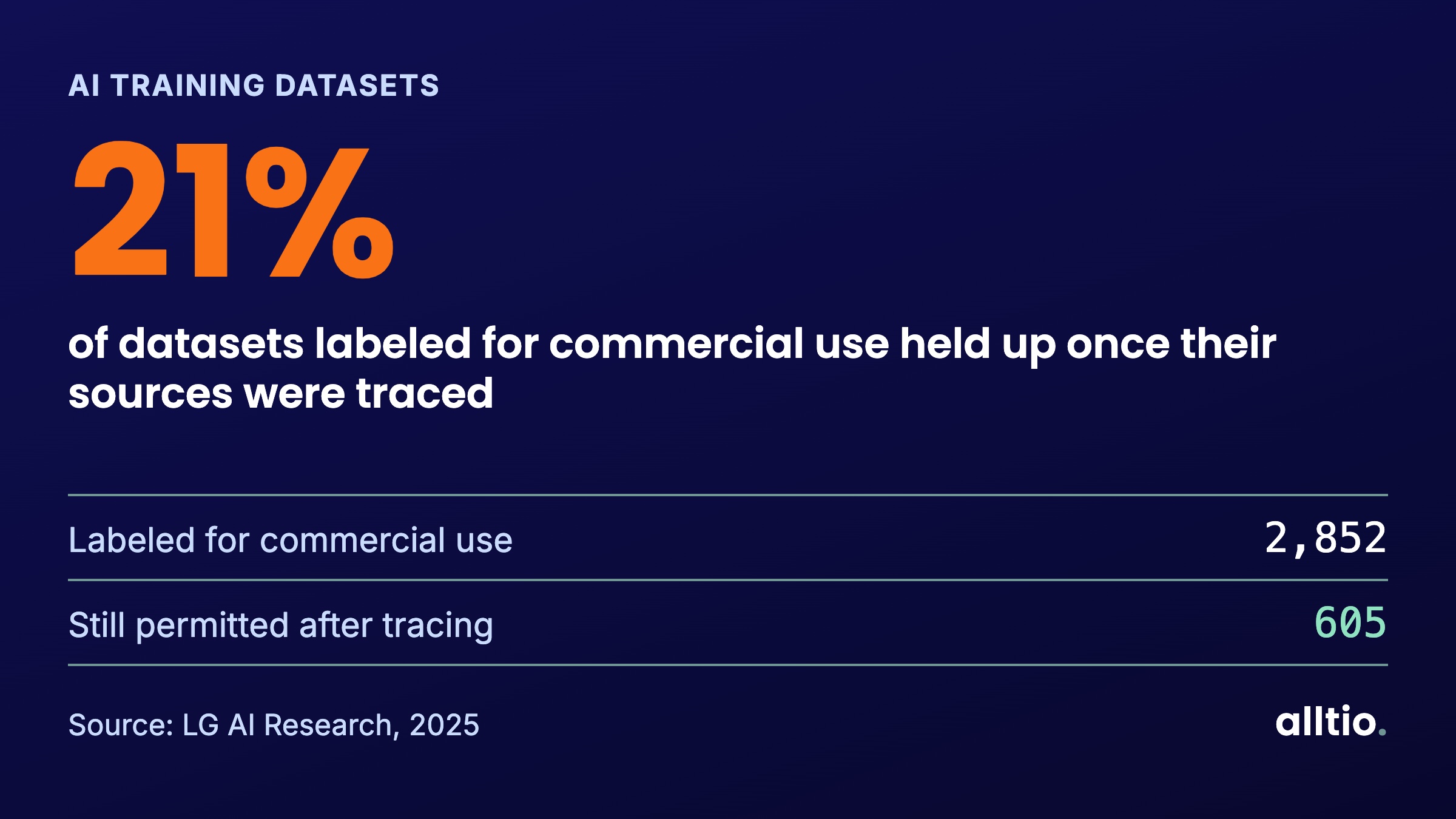
The research explains why LG built the agent. In a paper titled "Do Not Trust Licenses You See," posted to arXiv in March 2025 with no indication on its listing of peer review, eight LG researchers traced 3,612 widely used datasets. Most were among the most downloaded on Hugging Face, and the trace ran through 17,429 linked entities and 8,072 sets of license terms. Of 2,852 datasets whose own terms allowed commercial use, only 605, or 21%, remained permissible once every dependency was taken into account.
The paper names the mechanism. An inversion occurs when a dataset higher in the dependency graph carries a lower risk class than a source beneath it, so the derivative looks safer than the material it was built from, and the authors found inversions in 84.4% of multi-layered entities. They also identified 9,905 redistributions that broke their sources' terms, 8,268 of them where redistribution was prohibited outright.
Each layer can restate the permission, and none of those layers is the author
A dataset license is a statement by whoever published that dataset. The paper's own example is a collection released under CC BY 4.0 that depends on material licensed CC BY-NC 4.0, which bars commercial use. The label at the top was written by the party that assembled the collection, and the author of the material underneath was never asked to confirm or revise anything.
Nexus is built to recover what was lost on the way down. It walks the graph back toward the origin, through about three layers on average and as many as 16, and grades the result in seven classes from A-1 to C-2. The walk can only be as good as the first entry it reaches, and for a field engineer's maintenance note copied from a trade forum into a scraped corpus, that first entry is a web page carrying no declaration from anyone.
Europe assigns the reservation to the rights holder, while the label belongs to the compiler
LG says its framework covers Korea's AI Basic Act and the EU AI Act. Article 4(3) of the 2019 copyright directive lets text and data mining proceed unless rights holders have expressly reserved use, by machine-readable means for content made publicly available online. Article 53 of the AI Act requires providers of general-purpose models to operate a policy that complies with those reservations and to publish a sufficiently detailed summary of training content, and it does not require naming individual works.
A permissive label added by a compiler is not a statement by the rights holder. A provider that builds its Article 53 policy on dataset labels is therefore relying on the word of a party the directive does not name, and in LG's sample that word failed for nearly four in five datasets that claimed commercial use.
Music fixed the identifier at the source and let ownership change around it
In my experience in licensing, the systems that settle reliably keep who made a thing apart from who handles it later. The recording industry's ISRC is normally assigned by the first owner of a recording, and IFPI's guidance states that "the ISRC should not be changed" when ownership moves, with ownership data held separately so it can be updated. Distributors and services obtain the code from the owner and carry it, which lets a stream metered on any service be matched to the same recording however many times the catalog has been sold.
Training data never had that first assignment. Each compiler writes its own license line, the next compiler copies or rewrites it, and a tracing agent arrives years later to reconstruct a chain that nobody at the origin started.
A tracing agent needs a first entry written by the rights holder
Alltio is the registry of works. A creator or publisher scans a work on their own device, the scan produces a fingerprint, and the record binds that fingerprint to the rights holder and a declaration of the terms on which AI may use the work. Registration is the provenance, and it gives an agent such as Nexus a first entry made by the party the directive names rather than by the last party to repackage the text. Alltio makes no claim that any lab's compliance system reads its records today.
An Alltio record is not a US Copyright Office registration and confers no statutory remedy. No payment is flowing today, and Alltio has no access to AI lab logs and cannot observe AI use. Attribution follows once AI labs provide the usage records that show which registered works were used, settlement is then metered in AI compute tokens, and an off-ramp converts those AI compute tokens to currency.
LG has made diligence on the buyer's side faster and cheaper. The supply side has nothing comparable, since labs meter AI compute tokens to bill the buyer of each answer and nothing meters on behalf of the supplier of the knowledge inside it. Alltio delivers the long tail of specialist knowledge to AI labs as a collective, so a lab has one agreement rather than tens of thousands, against records whose first entry came from the rights holder.
Creators and publishers can register their work at alltio.com/register.
 Digital ID