The New York Times and three other newspapers sued Brave on November 2 over a web index sold to AI companies by the call, and the seller's published rates show exactly what the supply side of that transaction lacks.
On November 2, 2026, The New York Times Company sued Brave Software in the Southern District of New York, case 26-cv-9549, and the Chicago Tribune, the Daily News, and the Orlando Sentinel filed a parallel complaint, case 26-cv-9554. Each pleads direct, contributory, and vicarious infringement, circumvention under the DMCA over a paywall setting in Brave's browser, and unjust enrichment over ad substitution. These are allegations, and PPC Land reported that Brave had not yet answered in court. In its separate dispute with News Corp, which Brave opened in 2025, the company has argued that indexing is fair use on which every search engine depends.
One side of retrieval already has a posted rate
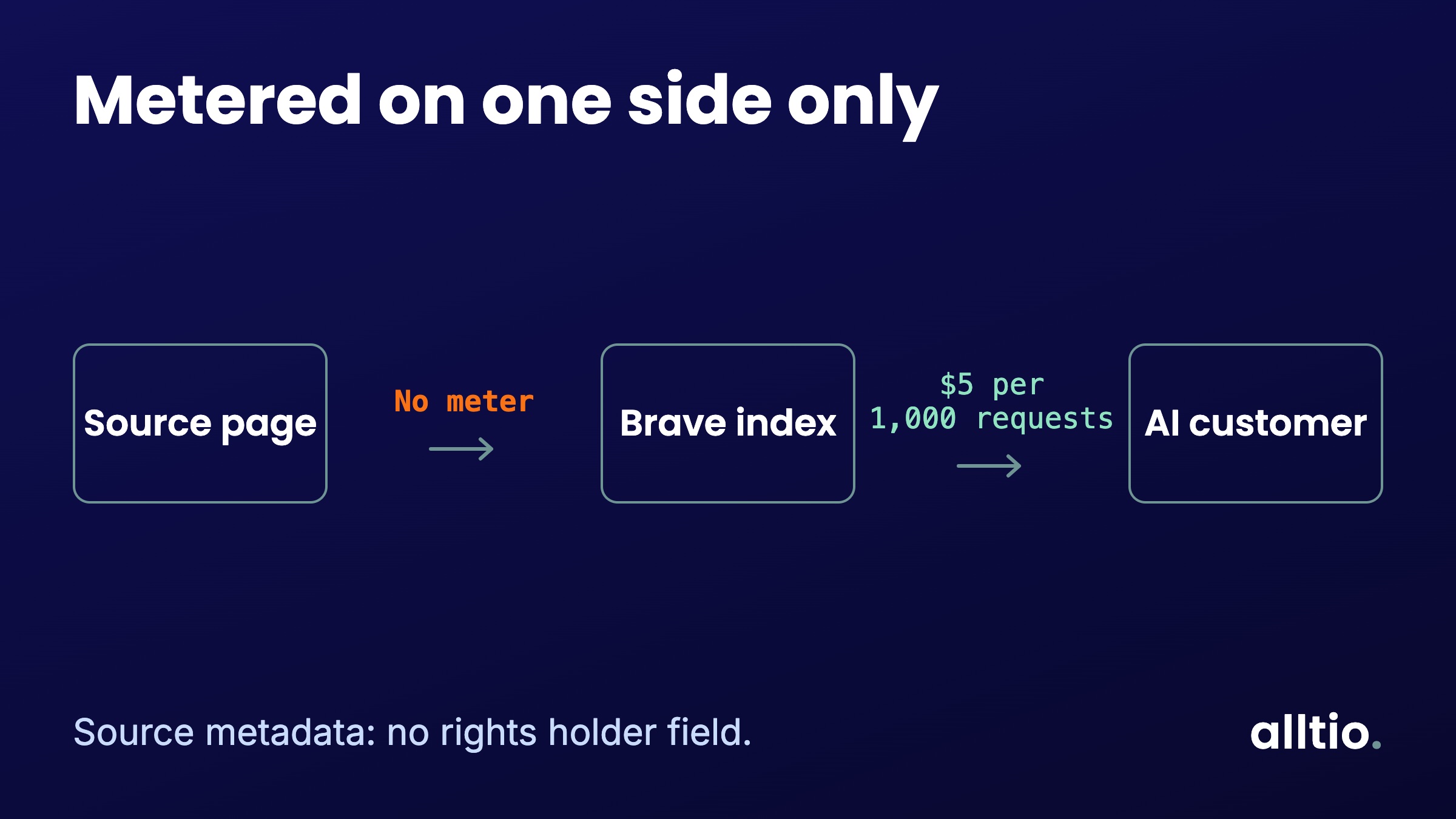
AI copyright plaintiffs usually have to reconstruct what a defendant took and what it earned from the taking. Here the seller posts a rate. Brave's Search API page lists Search at $5 per 1,000 requests and Answers at $4 per 1,000 requests plus $5 per million input and output AI compute tokens, with custom terms for enterprise buyers. Its LLM Context endpoint returns "extracted page chunks and source metadata" sized for a model's context window, and the Times complaint names Anthropic, Perplexity, Mistral, xAI, and Cohere as API customers, none of them a defendant.
Each call is rated and billed to the buyer, the same arrangement under which labs meter AI compute tokens for their own customers. Both complaints allege that Brave has never compensated the plaintiffs, and the public price list carries no line for the source of the passage.
Source metadata stops at the hostname
Brave's documentation specifies what travels with each result: the URL, title, hostname, and age, and on request the site name, favicon, thumbnail, description, and time of the last fetch. It lists no author and no rights holder. For The Times that gap is survivable, because nytimes.com resolves to one company that claims over 10 million registered works.
Hostnames map far less cleanly across the long tail. A soil scientist's field manual on a county extension site, or a contract actuary's memo republished by a trade body, reaches the buyer under the name of whoever runs the server. A perfect log of those API calls would still identify a host, leaving the person entitled to set terms outside the record.
One pleading covers two zero-click channels with different economics
Ask Brave composes an answer inside Brave Search, and the Times complaint says Brave Search handles more than 50 million queries a day, a third of which lead to an AI-generated response. That is zero-click in its search form, and a publisher can at least watch referrals fall in its own analytics.
The API is the chatbot channel. A passage lands inside another company's product, whether the reader ever sees a link depends on that company's interface, and the publisher sees neither the call nor the answer. Damage in search shows up as a declining line on a dashboard, while a call served from Brave's index leaves no trace on the supplier's side.
A robots.txt file needs a name to address
Brave's crawler help page says the bot "does not advertise a differentiated user agent," and that it will not crawl what Googlebot cannot. The complaints treat that as concealment, while Brave's stated reason is avoiding discrimination against sites that admit only Google. Either way, the security team that administers robots.txt has no Brave line to write there. The controls the page describes are a Googlebot rule and a noindex tag, and a site applying either broadly pays for it in ordinary search visibility.
Luxembourg moved toward the answer layer while the AI Act summary stays at training
On November 3, Advocate General Szpunar advised the Court of Justice in Case C-250/25, Like Company, that real-time retrieval and reuse of press publications by chatbots may, in certain circumstances, infringe publishers' rights. The opinion does not bind the Court, which has yet to rule. Article 53 of the AI Act requires providers of general-purpose models to publish a sufficiently detailed summary of training content and to operate a policy that complies with rights reservations, and it does not require naming individual works. On that text, a passage retrieved from a third-party index at answer time falls outside what a training summary is written to show, so the layer Brave sells sits beyond that disclosure.
Transit carriers settled because the record named the far end
In my experience in telecom wholesale, a transit carrier could bill by the minute with confidence because the call detail record also identified the network that terminated the call. The termination fee had a payee before anyone argued about its level, and disputes stayed confined to rates and volumes. A retrieval API has built the retail half of that arrangement: a clean rate and a billable event, with no terminating party anywhere in the record. A judgment in New York would reach plaintiffs who hold registrations and can identify themselves, and it would leave that record as thin as it is today for everyone else.
The record has to name the work before the call
Alltio is the registry of works. A creator or publisher scans a work on their own device, the scan produces a fingerprint, and the record binds that fingerprint to the rights holder and a declaration of the terms on which AI may use the work. Registration is the provenance, and because the record is keyed to the fingerprint, it holds when the same text sits on a host that has no connection to its author.
An Alltio record is not a US Copyright Office registration and confers no statutory remedy. No payment is flowing today, and Alltio has no access to AI lab logs and cannot observe AI use. Attribution follows once AI labs provide the usage records that show which registered works were used, settlement is then metered in AI compute tokens, and an off-ramp converts those AI compute tokens to currency.
The Times can sue on over 10 million registered works. A specialist with one field manual cannot, and no lab will sign tens of thousands of agreements to reach that specialist, so Alltio delivers the long tail to AI labs as a collective, with one agreement against records that already state whose each work is and on what terms.
Creators and publishers can register their work at alltio.com/register.
 Fingerprinted