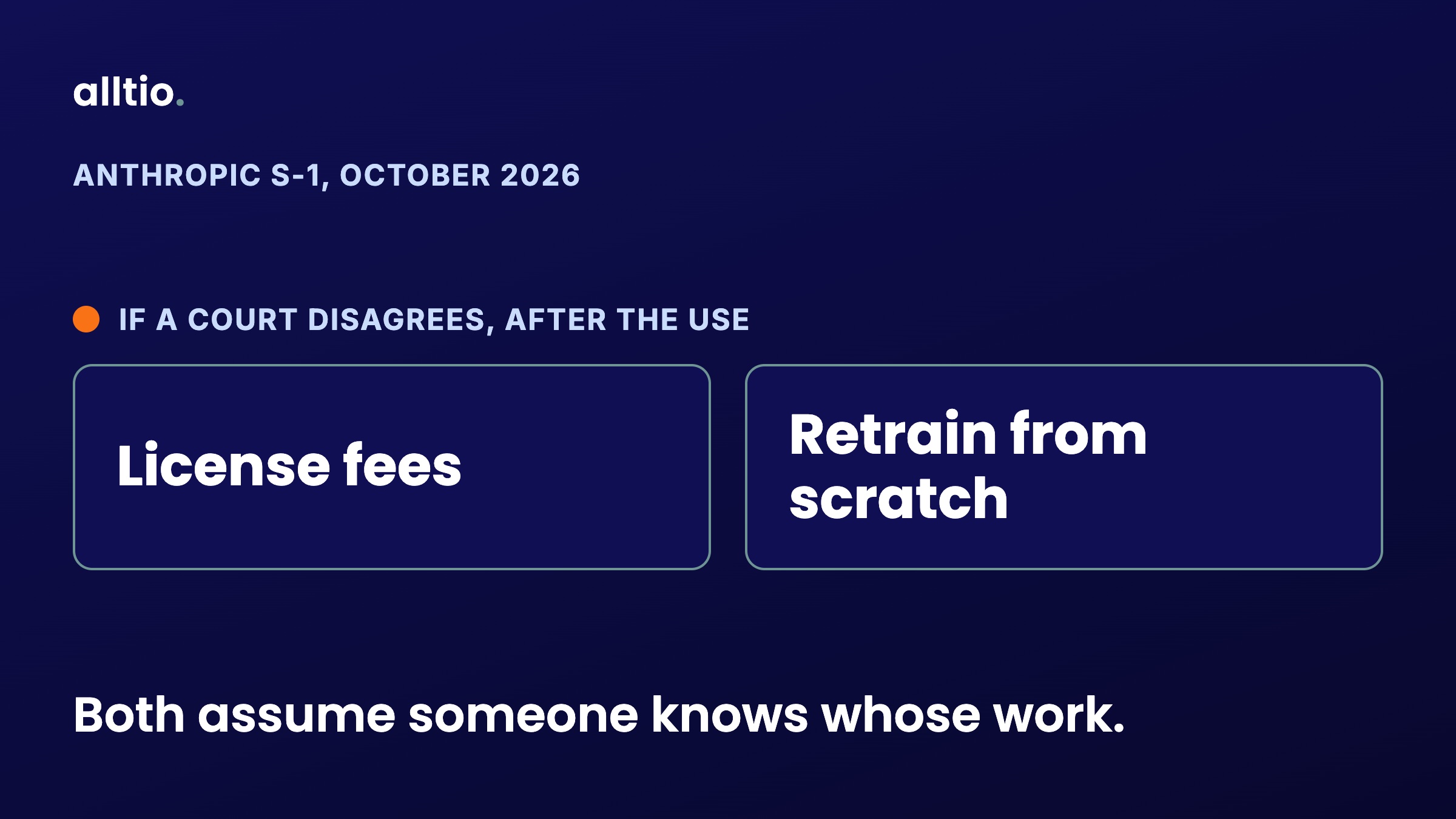
The S-1 that Anthropic filed on October 26 tells investors that an adverse ruling could mean licensing fees or retraining models from scratch, and each remedy depends on knowing which works went in and who holds the rights.
On October 26, 2026, Anthropic, PBC filed a Form S-1 registration statement with the US Securities and Exchange Commission, the document that precedes a public listing. Its summary statement of operations carries an operating expense line for the Bartz settlement, booked at $1.5 billion for 2025, the cost of resolving the authors' class action over pirated books. The risk factors reach well past that single payment. Anthropic states a good-faith belief that its use of training data is fair use, concedes that courts in the United States and elsewhere have not authoritatively resolved how copyright doctrine applies to model training, and sets out what follows if a judge disagrees.
The prospectus prices the remedy after the use
Two consequences are named. Anthropic may have to pay significant fees to obtain a license to the training data in question, and an adverse ruling against it or another developer could bring injunctive relief that may require it to "retrain affected models from scratch at substantial cost." Both sit in the conditional tense, and both would be priced by a court rather than by a market, years after the material entered the corpus.
Each remedy also carries an assumption the filing leaves unstated. A license needs a licensor, a party able to show which works were used and on what terms they may be used. Retraining without a work requires knowing which works to leave out, and for the long tail of specialist writing no list exists that would let an engineer exclude one author's papers while keeping another's.
A license reaches only the rights holders a lab can find
In the same risk section, Anthropic says it depends on relationships with data providers, licensors, and partners, and that it may be unable to obtain the datasets it needs through licenses or data partnerships. That channel serves whoever controls a catalog large enough to negotiate. The arrangements on record are access deals with platforms and publishers, struck at the level of the catalog with nothing metered work by work, so nobody can say what a single article contributed to an answer or what it earned.
The specialist whose technical notes or field research sit on a personal site, a university repository, or someone else's platform has no agent at that table. Material of that kind is often the only source for the question it answers, which is why its absence from any licensing channel matters to the quality of the answer. No lab will draft tens of thousands of separate licenses to reach it, so a prospectus can only carry that material as exposure to be priced later, by someone else.
Europe has no fair use, and its exception turns on a reservation
The filing acknowledges that copyright laws in some jurisdictions outside the United States generally do not recognize fair use. In the European Union the operative rule is Article 4 of the 2019 copyright directive, which permits text and data mining of lawfully accessible works unless their rights holders have expressly reserved them in an appropriate manner, such as machine-readable means for content published online. Article 53 of the AI Act then requires every provider of a general-purpose model to operate a policy that identifies and complies with those reservations and to publish a sufficiently detailed summary of its training content, a duty that does not extend to naming individual works.
Europe therefore settles the question before the use, and it settles it through an act of the rights holder. A reservation written into a site's configuration speaks for whoever runs the server and says nothing once the same text is syndicated, quoted, or republished at another address. For a reservation to follow the work, it has to be bound to the work itself.
Britain's grid pays rooftops because the meter came first
Electricity already pays a dispersed supply side, and it does so without litigation. Since January 1, 2020, licensed electricity suppliers in Great Britain with at least 150,000 domestic customers have had to offer a Smart Export Guarantee tariff to small generators, covering solar, onshore wind, hydro, and anaerobic digestion installations of up to 5 MW. The tariff must exceed zero pence per kilowatt-hour at all times. The exported power must be measured by a meter capable of half-hourly readings, and the installation must be certified, typically with an MCS certificate, before a supplier pays for a single unit.
The order is fixed. The installation is identified and certified, the meter records what it supplies, and the supplier settles against that record at a tariff set in advance, so no household has to sue a utility to establish that its panels exported power last winter. AI runs its meter on one side only: labs meter AI compute tokens to bill the buyer of every answer, while nothing meters on behalf of the supplier of the knowledge inside it.
The record has to exist before a court is asked
Alltio is the registry of works. A creator or publisher scans a work on their own device, the scan produces a fingerprint, and the record binds that fingerprint to the rights holder and a declaration of the terms on which AI may use the work. Registration is the provenance, and it answers in advance the two questions that both of Anthropic's contingent remedies leave open, namely which work and whose. An Alltio record is not a US Copyright Office registration and confers no statutory remedy.
The later steps depend on the labs. No payment is flowing today, and Alltio has no access to AI lab logs and cannot observe AI use. Attribution follows once AI labs provide the usage records that show which registered works were used, settlement is then metered in AI compute tokens, and an off-ramp converts those AI compute tokens to currency.
A prospectus that prices licensing fees and full retraining as contingencies describes a buyer with no practical route to the long tail before a judge sets the terms. Alltio delivers that long tail to AI labs as a collective, so a lab signs one agreement rather than tens of thousands, against records that already state whose each work is and on what terms. Creators and publishers can register their work at alltio.com/register.
 Fingerprinted