A Berlin researcher's inspection of the engines that feed ChatGPT, reported on October 27, shows supplier identity traveling with the text only where an access deal exists, so the long tail of specialist knowledge reaches the answer as unnamed excerpts.
On October 27, 2026, The Decoder reported an analysis by David Konitzny, a researcher at the Berlin startup Peec AI, of how news content reaches ChatGPT. Of three news engines configured inside the product, only one, code-named labrador, fills a field called "provider," and that field resolves to 12 publishers operating 43 domains, among them Condé Nast, Hearst, Axel Springer, News Corp, Reuters, and the Associated Press. Partner pages are not fetched live. They arrive as summaries prepared in advance and sit ahead of every ordinary web result in the material the model works from, while all other pages arrive as raw text excerpts.
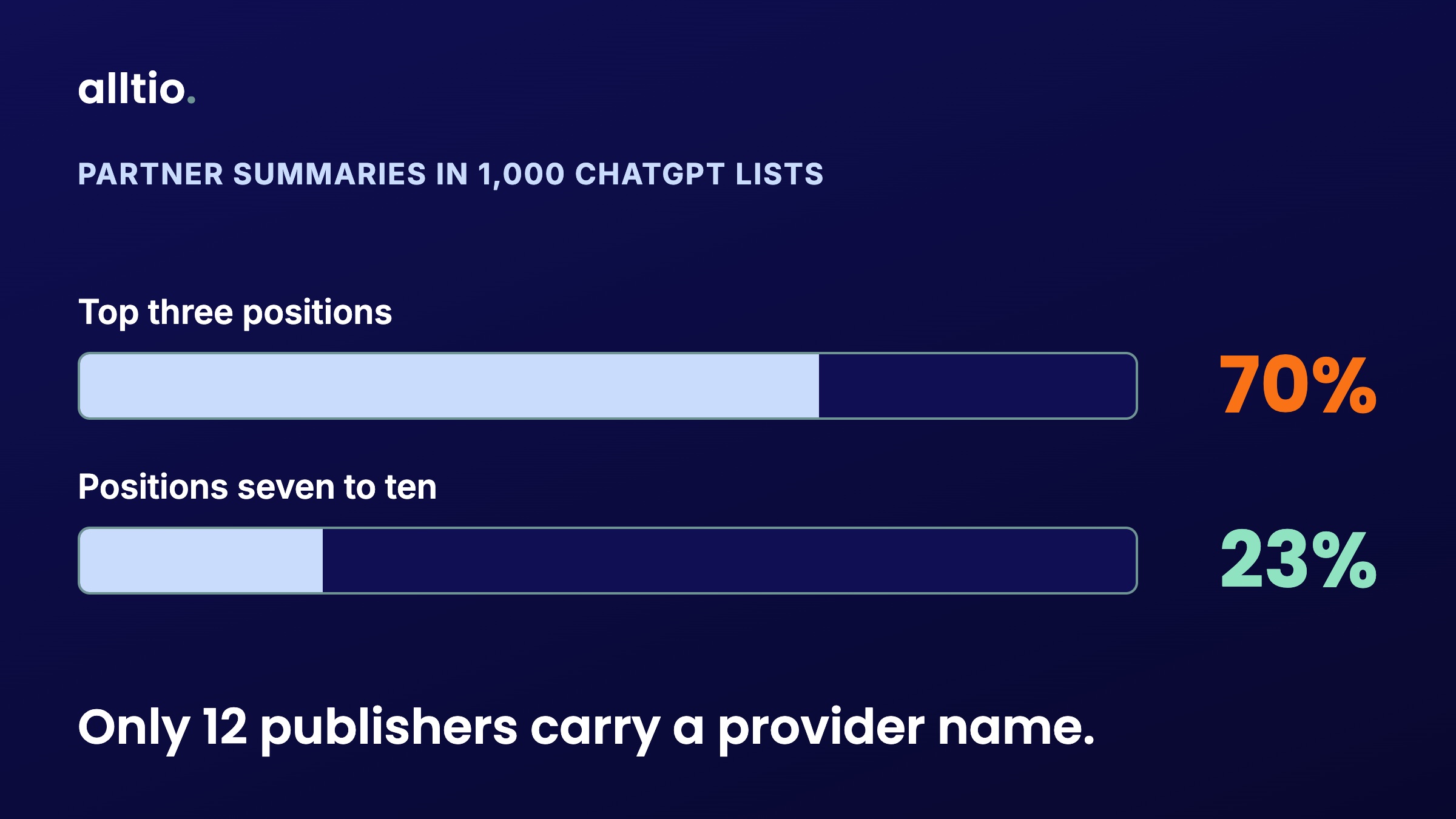
Across 1,000 ranked lists that Konitzny examined, partner summaries accounted for 70% of the entries in positions one to three and 23% of the entries in positions seven to ten. He published the work on LinkedIn, and The Decoder's report carries no comment from OpenAI, so the findings describe what an outside analyst observed in the product rather than anything OpenAI has documented.
The supplier's name travels only when a contract carries it
The provider field settles a question the industry still treats as open, namely whether an answer pipeline can carry the identity of whoever supplied a piece of text. It can. In this pipeline it does so for the publishing groups that have signed access deals with OpenAI, and the name it carries belongs to a company holding 43 domains rather than to the reporter or specialist contributor whose work is being summarized. Nothing in that design meters which article informed which answer.
Everything outside the deals enters as a fragment. A specialist who publishes on a personal site, in a university repository, or on someone else's platform reaches the model as an excerpt with nothing in the provider field, ranked behind material that arrived summarized and named. Rarity does not change that position, because the field is filled by contract and the specialist has no counterparty to sign with.
Inside the chatbot, position stands in for the visit
This is the chatbot channel, where the answer is composed inside the app with no results page around it, and it is a separate product from search with AI previews. A reader who gets the answer there has little reason to open the source. What a supplier receives is a place in the answer, and Konitzny's figures show partner material taking three times the share of the top positions that it takes lower down.
That allocation is the whole of what reaches the supply side. Labs meter AI compute tokens to bill the buyer of every answer, while nothing meters on behalf of the supplier of the knowledge inside it, whether the supplier is named in a provider field or not.
Recorded music names the self-released track the way it names a catalog release
In my experience in music licensing, the working precedent is the International Standard Recording Code. Every sound recording or music video can carry a 12-character ISRC, administered internationally by the ISRC Agency at IFPI in London, and the code identifies that recording uniquely and permanently. A self-releasing artist can assign one online, and the code stays a fixed point of reference wherever the recording goes, across services, borders, and licensing deals.
The sequence is what matters. The identity exists before the recording reaches any service. A track from a bedroom studio carries the same kind of identifier as a release from a major catalog, and a service that meters streams has something to attach each stream to. The provider field runs the other way: the deal grants the identity, and a supplier without a deal has no name in the pipeline.
Europe asks for reservations to be honored and never asks whose an excerpt is
Article 4(3) of the 2019 copyright directive lets text and data mining proceed unless rights holders have expressly reserved their works in an appropriate manner, such as machine-readable means for content published online. Article 53 of the AI Act requires providers of general-purpose models to operate a policy that identifies and complies with those reservations and to publish a sufficiently detailed summary of training content, and neither duty requires naming individual works. Nothing in either provision asks a provider to state, for an excerpt retrieved into an answer, whose work it is.
A Berlin researcher had to reverse-engineer a configuration to learn which suppliers this pipeline recognizes. A rights holder in Lyon or Leipzig has no comparable way to learn whether a work entered it at all.
The record has to exist before a provider field can be filled
Alltio is the registry of works. A creator or publisher scans a work on their own device, the scan produces a fingerprint, and the record binds that fingerprint to the rights holder and a declaration of the terms on which AI may use the work. Registration is the provenance, and it gives a work an identity before any deal exists, the same order the recording code follows. An Alltio record is not a US Copyright Office registration and confers no statutory remedy.
The later steps depend on the labs. No payment is flowing today, and Alltio has no access to AI lab logs and cannot observe AI use. Attribution follows once AI labs provide the usage records that show which registered works were used, settlement is then metered in AI compute tokens, and an off-ramp converts those AI compute tokens to currency.
Twelve publishers could negotiate their way into a provider field. The tens of thousands of specialists who make up the long tail cannot, and no lab will sign that many agreements to reach them. Alltio delivers that long tail to AI labs as a collective, so a lab signs one agreement rather than tens of thousands, against records that already state whose each work is and on what terms. Creators and publishers can register their work at alltio.com/register.
 Fingerprinted