
An academic publisher's November 4 suit against xAI describes a lab that sorts books by rarity at intake, and the EU training summary for Grok names no work and no rights holder.
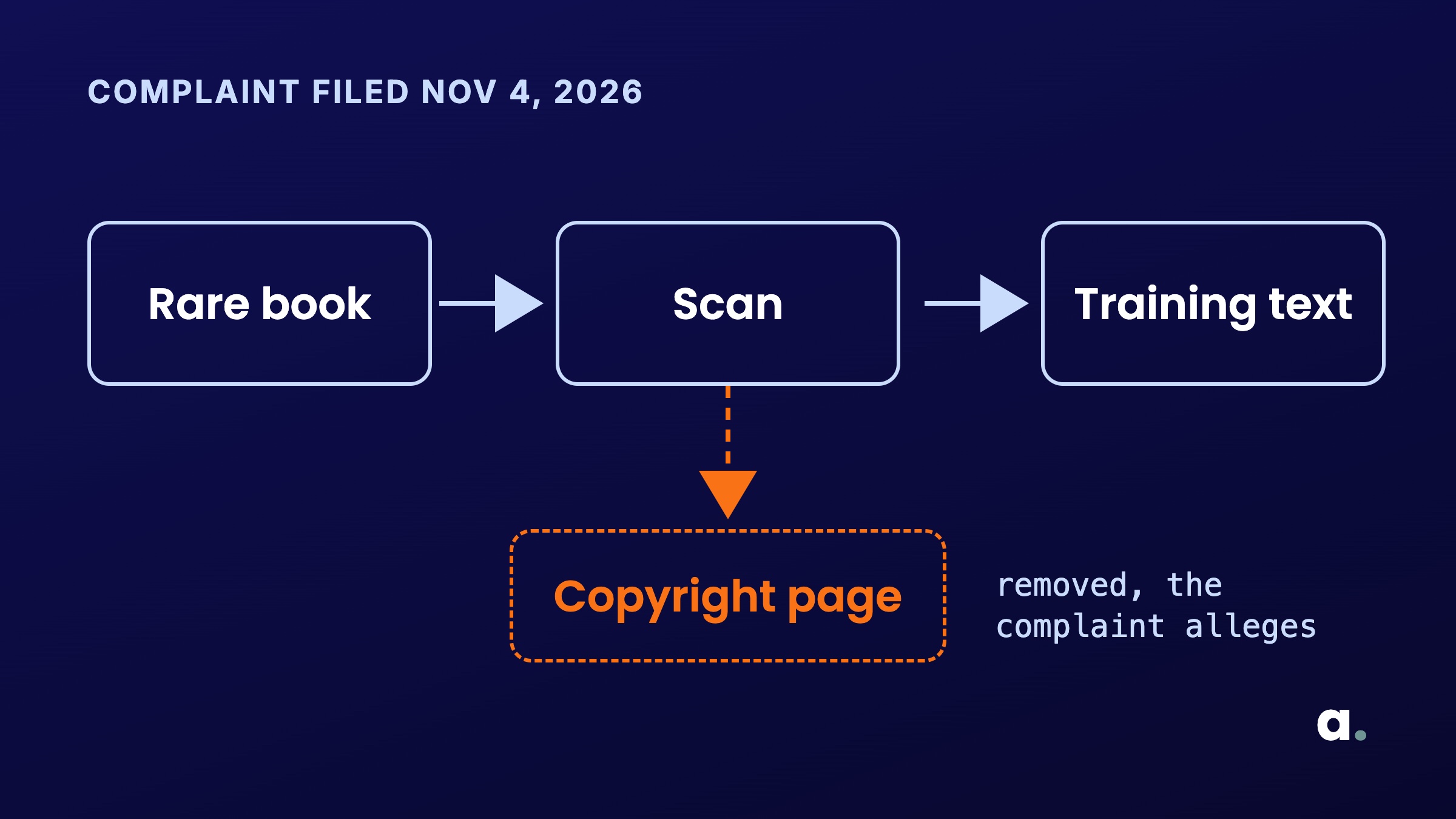
On November 4, 2026, Cognella, an academic publisher whose catalog of textbooks and course materials has grown over more than 30 years, sued xAI in the Northern District of California, Case No. 3:26-cv-13189. The defendants are three entities now named SpaceX Super Intelligence and formerly X.AI, and Cognella has chosen to sue on its own account rather than as a class. The same firm, Stris & Maher, filed companion suits against the same defendants for other publishers, Chicken Soup for the Soul among them. None of the allegations has yet been tested in court.
The buyer sorted its intake by rarity
The complaint builds its scanning count on a July 27 post in which Elon Musk said he had asked the team to "preserve any rare books in a library and scan them the hard way." Cognella reads that post as describing two tracks: rare volumes kept whole beside their scans, and ordinary copies put through the faster method Musk contrasted it with, cutting off the spine. Whatever a court decides about fair use, the instruction is a statement about value made by a buyer of training data, and it ranks a book held in a few libraries above a bestseller held in every public library.
That ranking matches how a model uses what it reads. Common text arrives in thousands of near-identical copies, and xAI's training summary for Grok lists deduplication among its preprocessing steps, so most of it collapses into one signal. A rare monograph, a regional history, or an out-of-print engineering manual carries information the model cannot find anywhere else, which makes the scarce work more likely to be what a specific answer depends on.
The complaint says the copyright page was what the conversion removed
Cognella alleges that when xAI turned scanned page images into training text, it removed the copyright page and the rest of each book's front matter. Those pages carry the title, the author, the publisher, and the copyright notice, and the complaint pleads their removal as a separate count under 17 U.S.C. § 1202(b)(1), the provision on copyright management information. If the allegation holds, the careful handling kept the object and the text and discarded the one page in the book that says whose it is.
Grok's EU summary lists categories and never names a rights holder
xAI's Public Summary of Training Content for Grok 4.7 is dated September 21, 2026, the day the model was placed on the Union market, and it names an authorized representative in Tallinn. It sorts the corpus into publicly available, licensed, third-party private, crawled, user, and synthetic data, and it names a handful of open sources such as Common Corpus and the OpenAlex and Crossref metadata. Its top web domains appear only as categories of site, and no individual work or rights holder is named anywhere in the document.
That is all the law requires. Article 53 of the AI Act obliges providers of general-purpose models to publish a sufficiently detailed summary of training content and to operate a policy that complies with rights reservations, and it does not require naming individual works. The summary's one concrete copyright filter operates on websites, since xAI says it treats the US Trade Representative's list of notorious markets for piracy as a signal for excluding sites. A blocklist of domains can keep a shadow library out of the crawl, and it has nothing to say about a book that arrived on a scanner bed.
Cognella cites the same summary in its complaint, so a document written to the EU AI Office's template is now evidence in a US court. The complaint also notes that xAI told a federal court, in its challenge to California's training data disclosure law, that the sources of its datasets are trade secrets. Between a summary that stops at categories and a source list held as confidential, the rights holder of a scanned rare book has no document that names the book.
In telecom, the handset and the subscription carry separate identities
In my experience in telecom, no operator confused the handset with the customer. The IMEI identifies the device and stays the same when the SIM changes, while the IMSI held on the SIM identifies the subscription, and usage is assigned to the subscription for billing. A network that logged every handset perfectly and lost the subscription identity would carry traffic it could never bill to anyone.
The same failure applies to a scanned book stripped of its front matter. The volume can be preserved and its text filtered with great care. Labs meter AI compute tokens to bill the buyer of every answer, nothing meters on behalf of the supplier, and a usage record has no party to name once the only statement of ownership has been cut away.
The statement of ownership has to sit outside the copy
Alltio is the registry of works. A creator or publisher scans a work on their own device, the scan produces a fingerprint, and the record binds that fingerprint to the rights holder and a declaration of the terms on which AI may use the work. Registration is the provenance, and because the record is held apart from any copy, nothing a pipeline later strips from a copy can remove it.
An Alltio record is not a US Copyright Office registration and confers no statutory remedy. No payment is flowing today, and Alltio has no access to AI lab logs and cannot observe AI use. Attribution follows once AI labs provide the usage records that show which registered works were used, settlement is then metered in AI compute tokens, and an off-ramp converts those AI compute tokens to currency.
xAI's own instruction says the rare volume deserves care. The authors and publishers of rare and specialist works are the suppliers no lab will contract with one at a time, so Alltio delivers that long tail of specialist knowledge to AI labs as a collective, and a lab signs one agreement rather than tens of thousands.
Creators and publishers can register their work at alltio.com/register.
 Digital ID