A claim filed in Ontario this month invokes a law that prices infringement per work, a remedy only a rights holder with an archive, a catalog of what it owns, and counsel on retainer can use.
On October 6, 2026, Postmedia, Torstar, The Globe and Mail, and The Canadian Press filed a statement of claim against Anthropic in an Ontario court, and The Canadian Press reported it on October 16. The publishers allege copyright infringement, breach of their websites' terms of service, circumvention of technological protection measures, and unjust enrichment from using their journalism to develop Claude. They also allege that Anthropic continues to scrape their content in response to user prompts. None of it has been tested in court, and Anthropic had not responded to requests for comment when the reports ran.
The remedy is priced per work, after the use
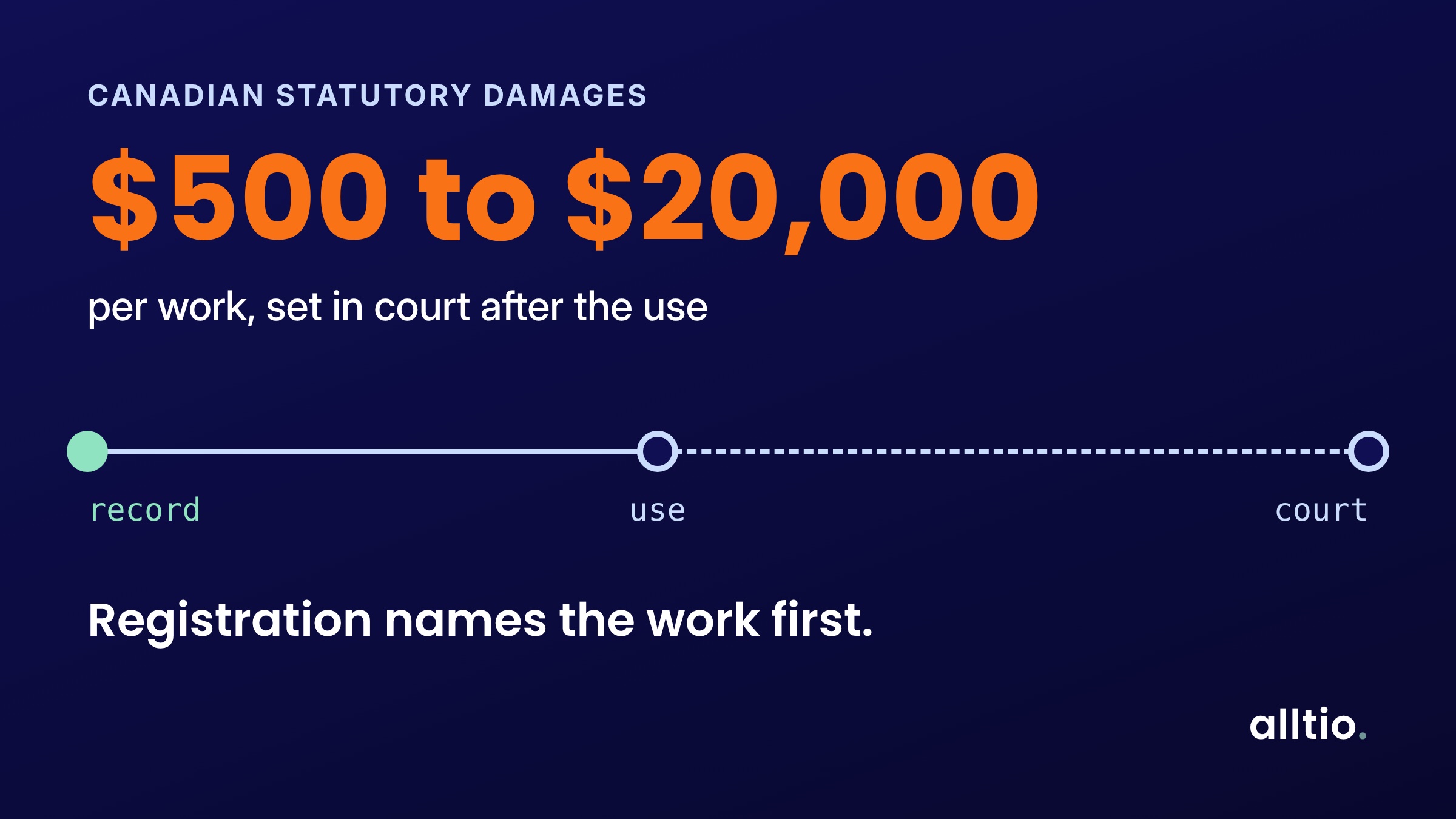
Canadian copyright law carries its own price list. Section 38.1 of the Copyright Act lets a copyright owner elect statutory damages of $500 to $20,000 per work for infringement committed for commercial purposes, with the court fixing the sum within that band. The unit of account is the work. Pricing arrives after the use, in a courtroom, from a judge who never saw the transaction.
That structure demands an inventory before it pays anything. A plaintiff has to name each work, show that it holds the rights, and give the court grounds to find copying. A national wire service can produce that from its own archive, with dated records of what it published and lawyers already engaged. The same publishers, joined by CBC/Radio-Canada, sued OpenAI in Ontario in 2024, and that case remains unresolved.
The specialist long tail cannot assemble the exhibit
Specialist knowledge is held differently. Its rights holders number in the tens of thousands, many publish on platforms they do not control, and few keep a dated register of what they wrote, where it went, and what rights they retained. For them a per-work remedy is theoretical, because the exhibit a court would need is the record they never made.
Litigation also looks only backward. Judgment clears the title to past use and sets no terms for the next request, so the newsroom that wins still has no meter running tomorrow, and the independent specialist never reaches the courthouse.
The allegation that matters is the request made at question time
Two kinds of use appear in the claim, and they leave very different evidence. Training absorbs text into weights, after which no record shows which document shaped which answer. A fetch made in response to a user prompt is a discrete event: one page, one question, one moment, which the party running the crawler is in a position to log.
That layer is where a work-level usage record could exist. Labs meter AI compute tokens to bill the buyer of every answer, and nothing meters on behalf of the supplier of the knowledge inside it. Where a fetch log is kept, it identifies an address, and an address names whoever hosts the page, which for most specialist work is someone other than the rights holder.
Search priced the page before anyone could dispute it
Search advertising ran on the opposite sequence. Google's own documentation describes an ad auction that runs every time an ad is eligible to appear, so every search starts the process again, with advertisers bidding against one another for the placement. Strangers set the price at the moment of use, the click carried the reader to the writer's page, and no writer had to prove anything to a judge to be paid through that traffic.
In my experience in telecom, settlement disputes show the same discipline from the other side. Carriers resolve contested interconnect bills by reconciling CDRs record by record, and the carrier that kept no records ends up negotiating from its counterparty's numbers. A court that must reconstruct per-work use from a defendant's logs, long after the fact, writes that weaker position into civil procedure.
Brussels asks for a summary and a reservation, and neither names the work
Europe regulates the front of the chain, though not at the unit in which Canadian damages are priced. Article 53 of the AI Act requires providers of general-purpose models to publish a sufficiently detailed summary of training content on the AI Office template and to operate a policy that identifies and complies with rights reservations made under Article 4(3) of the 2019 copyright directive. The Commission's template asks for the top 10% of scraped domains, and neither duty requires a provider to name individual works.
Article 4(3) leaves the reservation itself to rights holders, expressed in an appropriate manner, such as machine-readable means for content published online. A summary organized by domain and a reservation set site by site both stop one level above the work, which is the level at which Canada's statute, and any future usage record, has to operate.
The record has to exist before the use
Alltio is the registry of works. A creator or publisher scans a work on their own device, the scan produces a fingerprint, and the record binds that fingerprint to the rights holder and a declaration of the terms on which AI may use the work. Registration is the provenance, made before any request arrives, and it gives the work the identity that a domain, a training summary, and a statement of claim each try to reconstruct afterward.
Its limits deserve equal plainness. No payment is flowing today, and Alltio has no access to AI lab logs and cannot observe AI use. Attribution follows once AI labs provide the usage records that show which registered works were used, settlement is then metered in AI compute tokens, and an off-ramp converts those AI compute tokens to currency.
Publishers with archives and counsel can sue work by work. The long tail of specialist knowledge cannot, and no lab will sign tens of thousands of agreements to reach it, so Alltio delivers that long tail to AI labs as a collective, and a lab signs one agreement rather than tens of thousands, against records that already state whose each work is and on what terms. Register your work at alltio.com/register.
 Fingerprinted